Content Strategy Explained Step by Step (2026 Edition)
Most brands do not have a content problem. They have a content without a plan problem. This is the step-by-step process we use to decide what to publish, where, and why it should make money.
Key takeaways
- A content strategy answers four questions: who it is for, what problem it solves, where it lives, and how it leads to revenue.
- Start from audience questions and search demand, not from what the team feels like writing this week.
- Three to five content pillars keep output focused and build topical authority with search engines.
- Distribution deserves as much planning as creation. Most good content fails because nobody sees it.
- Measure content by the pipeline it influences, not only by page views or likes.
01What a content strategy is (and why most fail)
A content strategy is a plan that connects what you publish to a business goal. It decides the audience, the topics, the formats, the channels and the way success gets measured. Without it, content becomes a treadmill: lots of effort, very little direction.
We see three failure patterns again and again when brands come to us:
- Random acts of content. Posts happen because someone had an idea, not because they serve a plan.
- Content that talks about the company. Announcements and product features, when buyers want answers to their own problems.
- No distribution. A great article gets published, shared once, and forgotten.
Strategy fixes all three by forcing decisions up front. It should also sit on top of a clear brand strategy, so every piece reinforces the same position rather than drifting.
02Step 1: Set goals content can actually move
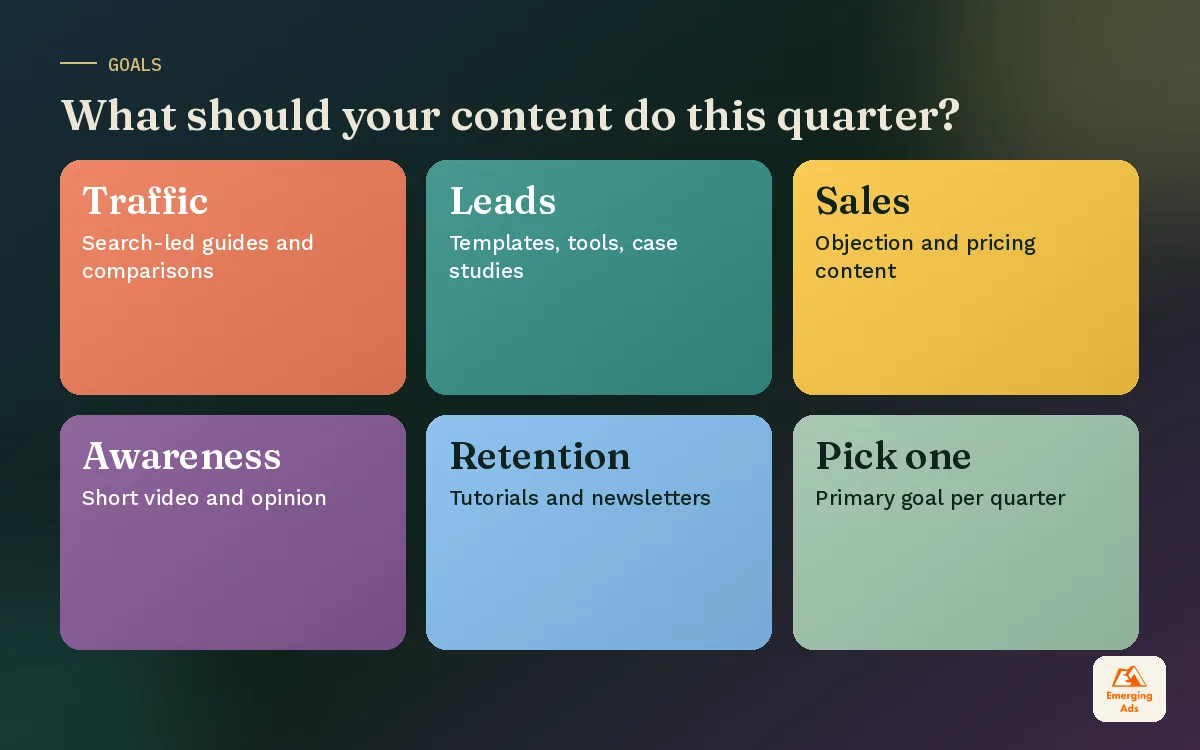
Content can do several jobs, but it rarely does all of them at once. Pick one primary goal per quarter and one or two supporting goals.
| Goal | Content that fits | Metric to watch |
|---|---|---|
| Organic traffic | Search-led guides, comparisons, how-tos | Non-branded clicks in Search Console |
| Lead generation | Templates, calculators, case studies, webinars | Content-assisted leads and form fills |
| Sales enablement | Objection handling, pricing guides, proof pieces | Sales cycle length, win rate on influenced deals |
| Brand awareness | Short video, opinion pieces, founder stories | Reach, branded search, share rate |
| Retention | Onboarding guides, tutorials, newsletters | Repeat purchase and churn |
If organic growth is the goal, your content plan and your SEO strategy should be built together, not handed between two teams.
03Step 2: Research your audience and search demand
The best topics come from two places: what your customers ask and what people search for. Combine both and you get content that is useful and findable.
Customer research
- Read support tickets and sales call notes. List every question asked more than twice.
- Mine reviews for the words customers use to describe their problem and the result they got.
- Ask your sales team which objections stall deals. Each one is a content brief.
Search research
- Use keyword tools to find the questions and comparisons people search around your offer.
- Check the People Also Ask boxes and related searches in Google for each core topic.
- Look at your paid search term reports. They show exactly how buyers phrase their intent.
- Note the format that ranks for each query. If the top results are all checklists, write a better checklist.
04Step 3: Choose your content pillars
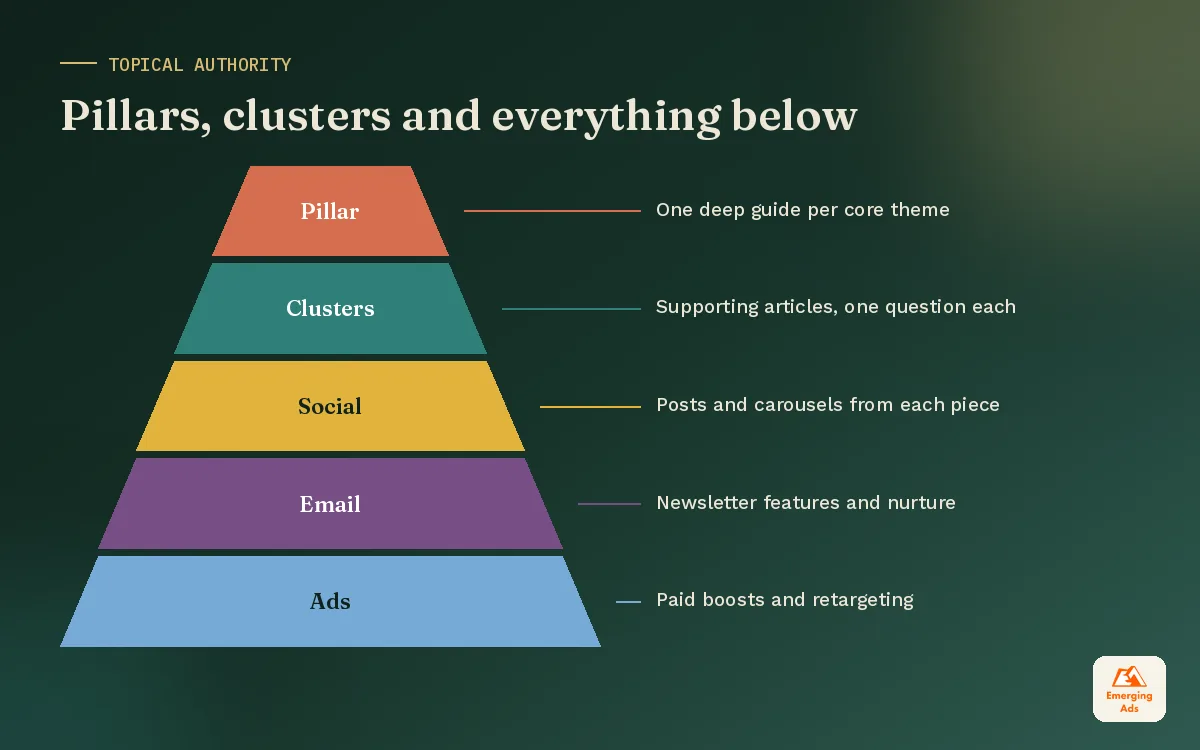
Content pillars are the three to five themes you commit to covering in depth. They keep the team focused and help search engines understand what your site is an authority on.
A good pillar sits where three things overlap: what your audience cares about, what you are qualified to talk about, and what connects to what you sell. For a branding studio, pillars might be brand strategy, visual identity, brand voice, content production and brand performance. That is roughly how this very site is organised.
Pillar pages and clusters
Each pillar gets one comprehensive guide and a cluster of supporting articles that link back to it. Supporting pieces go deep on one question each. The internal links between them tell search engines the topic is covered thoroughly, which is how topical authority is built over time.
05Step 4: Pick formats and channels
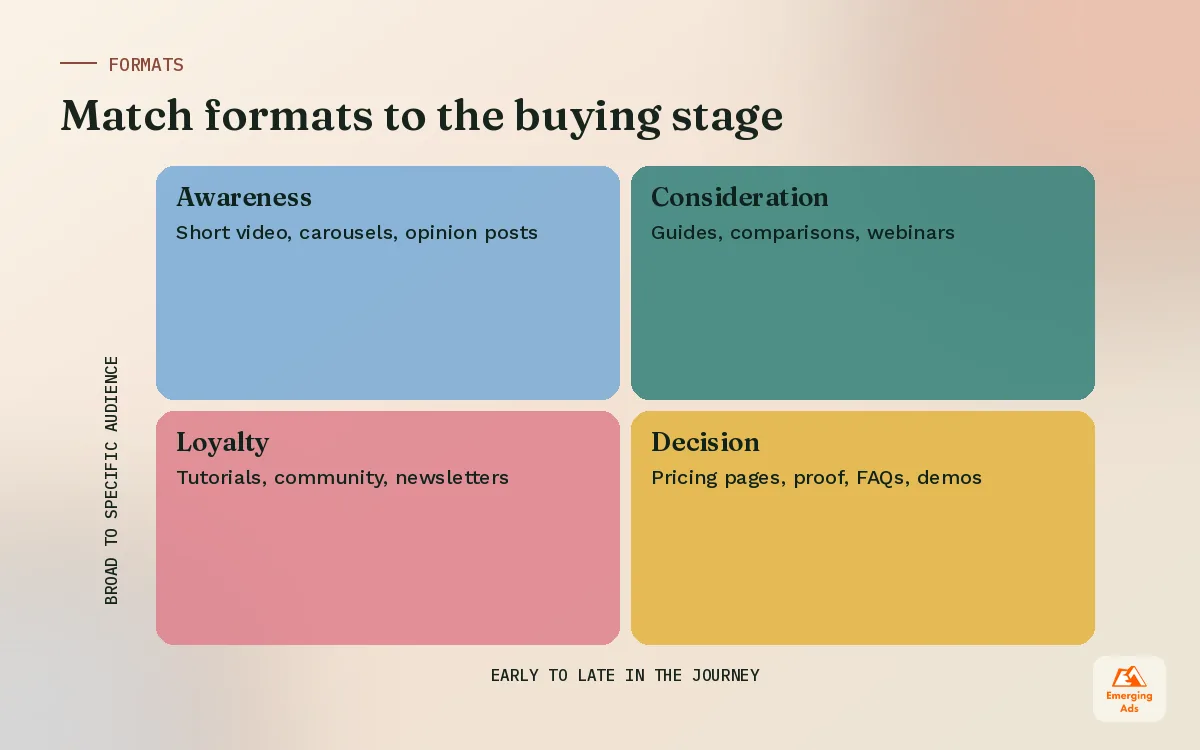
Different formats suit different stages of the buying journey. Plan a mix instead of defaulting to blog posts for everything.
| Stage | Formats that work | Main channels |
|---|---|---|
| Awareness | Short video, carousels, opinion posts, podcasts | Instagram, TikTok, LinkedIn, YouTube |
| Consideration | Guides, comparisons, webinars, case studies | Blog and search, email, LinkedIn |
| Decision | Pricing pages, demos, proof pieces, FAQs | Website, retargeting ads, sales follow-up |
| Loyalty | Tutorials, community posts, newsletters | Email, WhatsApp, private groups |
Video deserves a special mention because it travels across almost every channel. One well-planned shoot can feed ads, social and your website for a month. Our video content production team plans shoots around exactly this kind of reuse. For social specifically, see how our social media management and Instagram management services turn pillars into weekly posts.
06Step 5: Build the calendar and workflow
A calendar turns strategy into output. Keep it simple enough that people actually update it.
- Set a realistic cadence. Two excellent articles a month beat eight rushed ones. Consistency matters more than volume.
- Assign each piece a pillar, goal and format. If a piece has no clear pillar, question whether it should exist.
- Write briefs, not titles. A brief includes the audience, the search intent, the angle, key points, sources, internal links and the call to action.
- Plan the distribution with the piece. Decide where it will be shared and repurposed before writing starts.
- Build in review. One person checks voice against your brand voice guide and facts before anything goes live.
If you want to understand what professional writing support looks like, our main site covers what blog writing services include and when they are worth paying for.
07Step 6: Distribute and repurpose
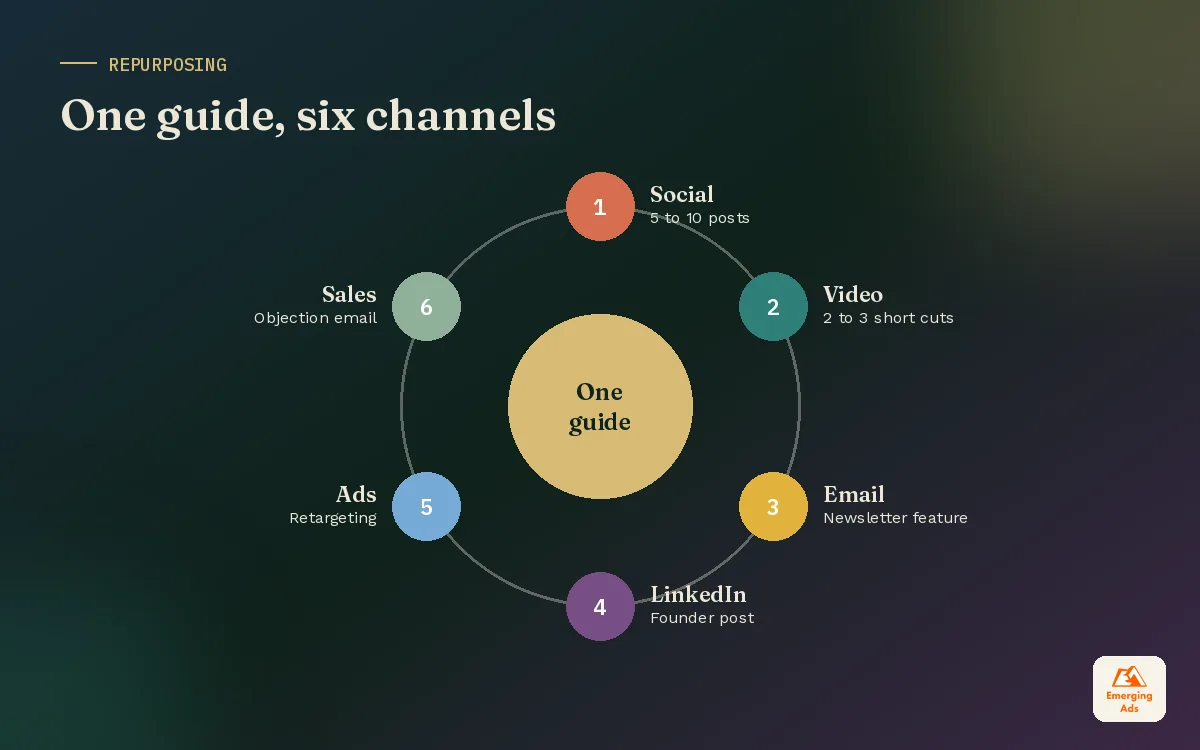
The rule we follow is simple: spend at least as much effort getting content seen as you spend making it. A single strong guide can become:
- Five to ten short social posts or carousel slides
- Two or three short videos pulling out the best points
- A newsletter feature for your email marketing list
- A LinkedIn post from the founder in their own words
- Retargeting ads that send warm audiences to the full piece
- A sales follow-up email that answers a common objection
Paid amplification is often the missing piece. Putting a small budget behind your best content on Meta or LinkedIn gets it in front of the right people quickly and builds warm audiences you can retarget later.
08Step 7: Measure what matters
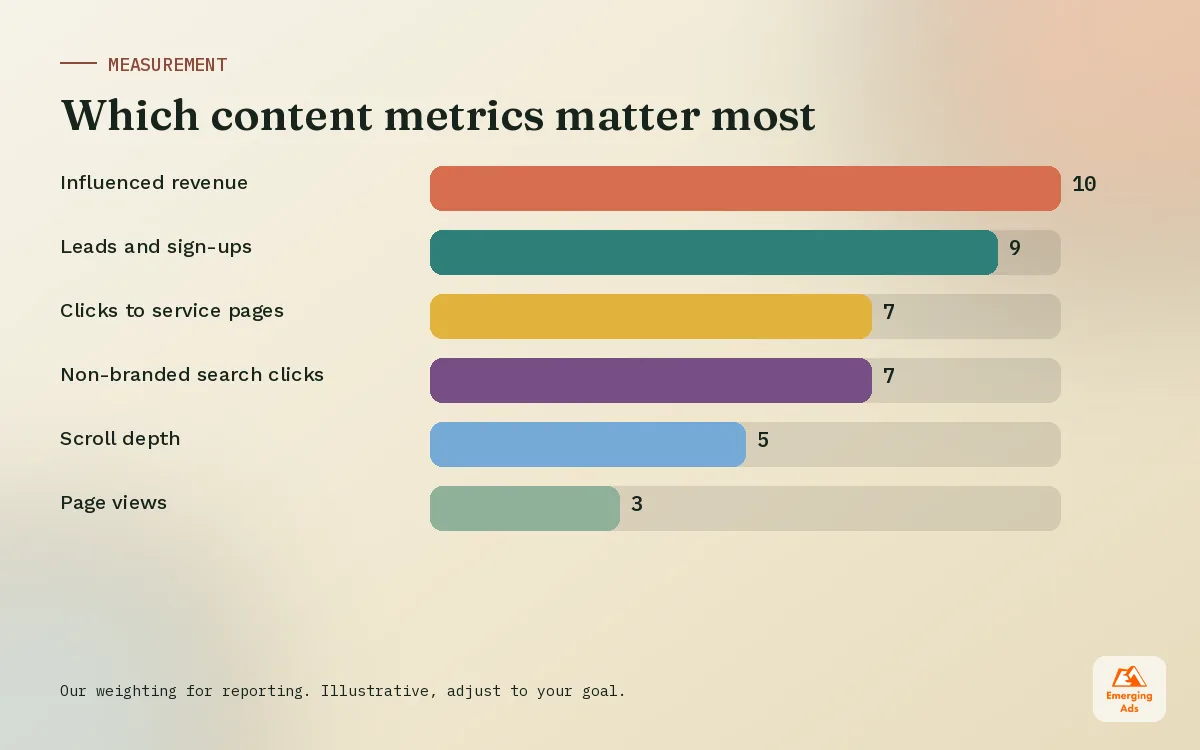
Measure content against the goal you set in step one. Page views alone tell you very little. A small number of the right readers can matter more than thousands of the wrong ones.
- Search: impressions, non-branded clicks and rankings for target queries in Search Console.
- Engagement: scroll depth, time on page and clicks to service pages.
- Conversion: newsletter sign-ups, lead form fills and demo requests influenced by content.
- Revenue: deals and orders where content appears in the path. A proper GA4 setup and attribution model make this far easier to see.
Review performance monthly and prune quarterly. Update pieces that are close to ranking, merge thin posts, and drop topics that never connect to revenue.
09A content strategy template you can copy
Here is the one-page template we fill in with clients before any content gets made. Copy it into a document and answer each line in one or two sentences. If a line is hard to answer, that is where your strategy needs work.
| Section | Question to answer | Example answer |
|---|---|---|
| Business goal | What should content achieve in the next 6 to 12 months? | Grow qualified demo requests from organic search |
| Audience | Who exactly are we writing for? | Marketing leads at small ecommerce brands doing their own ads |
| Core problem | What keeps them stuck? | They cannot tell which channel is actually driving sales |
| Our angle | What do we believe that others do not say? | Most attribution tools overcount, so trust blended numbers first |
| Pillars | Which three to five themes will we own? | Tracking, attribution, reporting, budget planning |
| Formats | What will we make, and how often? | Two guides a month, weekly carousels, one monthly webinar |
| Channels | Where will it live and travel? | Blog, LinkedIn, newsletter, retargeting ads |
| Conversion path | What should a reader do next? | Download a template, then book a call |
| Measurement | How will we judge success? | Non-branded clicks, template downloads, influenced pipeline |
Keep this template next to your brand strategy and voice chart. Together, those three pages are enough to brief almost any writer, designer or video team.
10Content strategy mistakes that waste budget
- Chasing volume keywords you cannot win. A new site will not outrank established publishers on broad terms. Start with specific questions your buyers ask.
- Writing for algorithms, not people. Keyword-stuffed pages rarely convert, and they age badly as search engines get better at judging usefulness.
- No clear next step. Every piece should point to one relevant action, such as a related guide, a template or a service page.
- Ignoring internal links. Linking related articles and service pages helps readers and helps search engines understand your site.
- Publishing and walking away. The best content gets updated. Refreshing a strong article is often worth more than writing a new one.
- Measuring the wrong thing. A viral post with no buyers in the audience is fun, but it does not pay salaries.
Most of these come down to planning. If the plan is right, the individual pieces get easier to write and far easier to measure. Brands selling online can also connect content directly to product pages, which is a big part of how we approach ecommerce marketing.
11A simple 90-day content strategy plan
| Period | Focus | Deliverables |
|---|---|---|
| Days 1 to 15 | Research and decisions | Audience questions list, keyword map, three to five pillars, goals |
| Days 16 to 30 | Foundations | Pillar guide for your top theme, briefs for the next eight pieces, calendar |
| Days 31 to 60 | Production rhythm | Weekly publishing, repurposing into social and email, first paid boosts |
| Days 61 to 90 | Measure and adjust | Performance review, update underperformers, second pillar guide |
Ninety days is enough time to see early signals in social and email, and to start seeing search impressions grow. Organic rankings usually take longer, so do not judge the whole strategy on month one. If you want help building yours, our content strategy services team works alongside brand strategy and paid media, so content is planned to perform from the first brief. Start with a free audit of what you already have, or explore the wemergingads.com homepage for more on how we work.
Frequently asked questions
Straight answers to what clients ask us most about content strategy.
What is a content strategy?
How do I create a content strategy?
What is the difference between content strategy and content marketing?
What are content pillars?
How often should a brand publish content?
How long does content strategy take to show results?
Do I need a content strategy for social media only?
How do you measure content ROI?
What should a content brief include?
Should content strategy be done in-house or by an agency?
What is repurposing content?
Publishing a lot but not seeing leads from it?
We will review your content, search visibility and social channels, then show you which pieces to keep, which to fix and what to stop making.
Book your free audit