Brand Voice: The Practical Guide We Hand to New Clients
Your brand voice is how you sound when nobody from marketing is checking. This guide shows how to define it in a way that works for ad copy, support emails and social captions, not just the homepage.
Key takeaways
- Brand voice is your personality in words. Tone is how that voice adjusts to the situation. You need one voice and several tones.
- Define voice with contrasts such as “direct, not blunt” and back each one with do and do not examples.
- Build your voice from real customer language pulled from reviews, calls and search terms.
- A one-page voice chart beats a 30-page guide. People use what they can remember.
- Test voice in paid ads first. Click-through and comment quality show quickly whether it lands.
01Brand voice vs tone: the difference that matters
Brand voice is the consistent personality that comes through in everything you write. Tone is how that personality adapts to the moment. You would not speak to a customer whose order went missing the same way you would write a launch announcement, but both should still sound like the same company.
Think of a person you know well. They speak differently at a funeral and at a birthday party, but you would recognise them with your eyes closed in both rooms. That recognisable core is voice. The adjustment to the room is tone.
| Brand voice | Tone | |
|---|---|---|
| Changes? | Rarely, it is part of your identity | Constantly, based on context |
| Defined by | Your brand strategy and personality | Channel, audience mood and goal |
| Example | Warm, plain-spoken, a little dry | Upbeat in a launch, calm in a complaint reply |
Your voice should come directly from your brand strategy, specifically the personality section. If you have not written that yet, start there. Voice built without strategy tends to end up as a list of pleasant adjectives that could describe anyone.
02Why brand voice matters for performance marketing
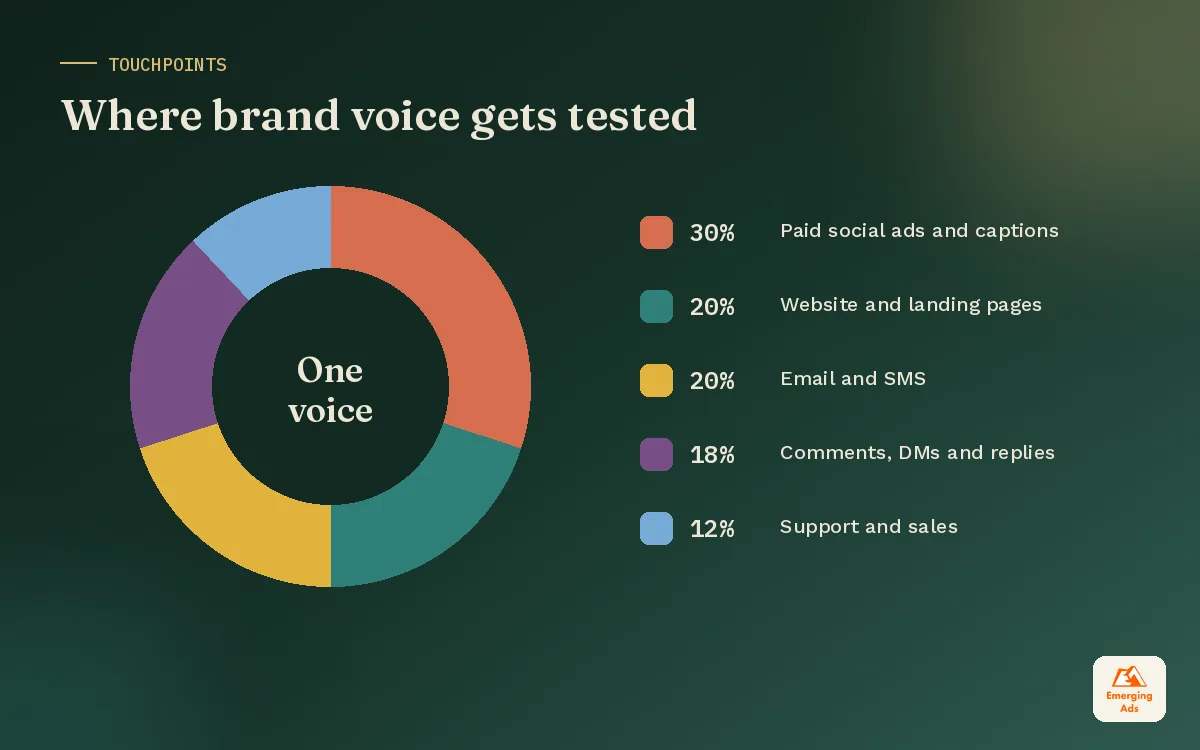
Voice sounds like a soft topic until you watch it in an ad account. In paid social, people decide in a second or two whether to keep scrolling. Generic copy blends into the feed. A recognisable voice gives people a reason to pause, and over time it lets them recognise you before they see the logo.
- Ads: a distinct voice makes hooks and headlines easier to write and easier to test. It also helps your Meta ads and TikTok ads feel native rather than corporate.
- Landing pages: if the ad sounds playful and the page sounds like a legal document, people feel the gap and leave. Consistent voice supports landing page conversion.
- Email: subscribers open emails from brands they like reading. Voice is a big part of why some newsletters get replies and others get unsubscribes. Our email copywriting service starts every project with a voice check for this reason.
- Social: comments, replies and DMs are where voice gets tested hardest, because they are written fast by different people.
03How to define your brand voice in five steps
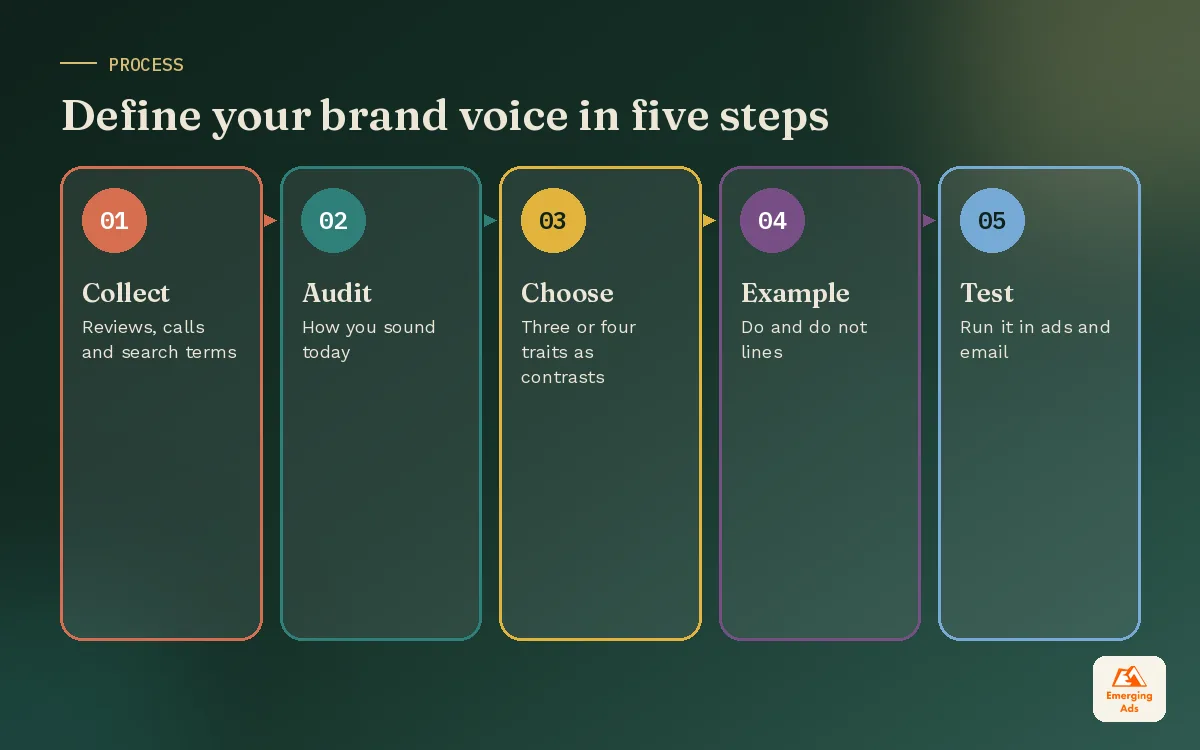
1. Collect real language
Pull 50 to 100 customer reviews, a handful of sales call transcripts and the search terms from your ad accounts. Highlight the phrases people use to describe the problem, the outcome and how they felt about you. This is gold. The best voice sounds like the customer on a good day.
2. Audit how you sound today
Gather your homepage, three recent ads, three emails, three social posts and a support reply. Read them in one sitting. Most teams discover they sound like three or four different companies depending on who wrote what.
3. Choose three to four voice traits
Pick traits that fit your personality and set you apart from competitors. Then write each one as a contrast so people know where the line is: “confident, not arrogant”, “friendly, not childish”, “expert, not academic”.
4. Write examples for each trait
For every trait, write one sentence that nails it and one that misses. Real examples teach faster than any description.
5. Test and refine
Rewrite one ad, one email and your homepage headline in the new voice, then run them. Paid social gives you feedback within days. Keep what works and adjust what does not.
04Brand voice examples: before and after
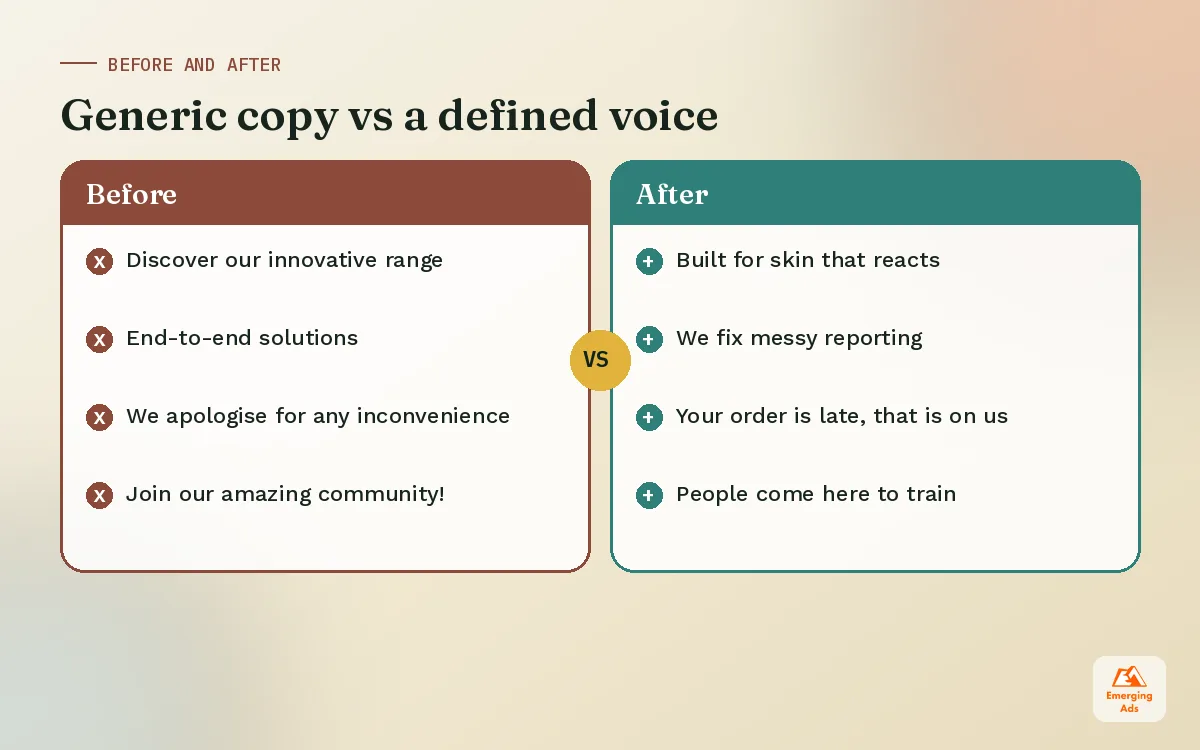
These are illustrative rewrites in the style of real work we do. They show how the same message changes when the voice is defined.
| Context | Before (no defined voice) | After (defined voice) |
|---|---|---|
| Skincare ad hook | Discover our innovative skincare range for all skin types. | Your skin reacts to everything. We built this for exactly that. |
| B2B homepage | We provide end-to-end solutions for your business needs. | We fix messy reporting so your team can stop arguing about numbers. |
| Order delay email | We apologise for any inconvenience caused. | Your order is late and that is on us. Here is what we are doing about it. |
| Gym social caption | Join our amazing community today! | No mirrors on the main floor. People come here to train, not to pose. |
The “after” versions are more specific, and specificity is what makes a voice feel real. Notice that none of them rely on exclamation marks or big adjectives.
05Building a brand voice chart
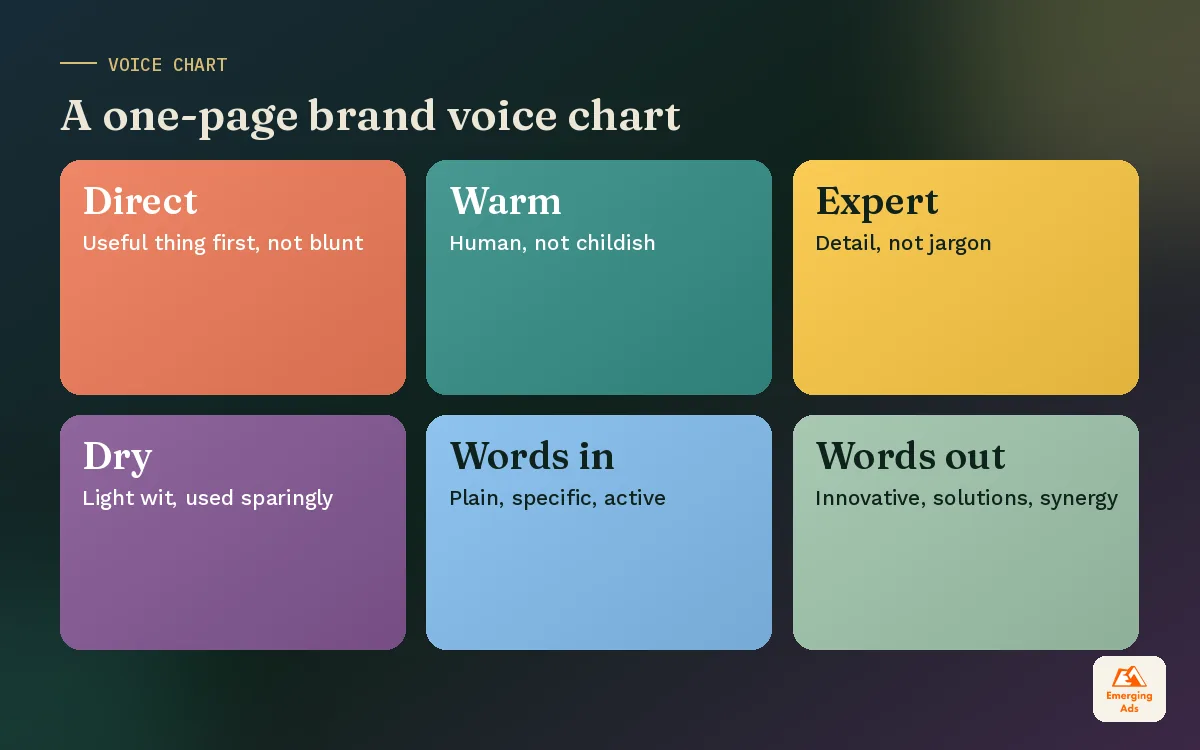
A voice chart is a one-page table that anyone on the team can use while writing. It is far more practical than a long voice guide, and it fits neatly into your wider brand identity system.
| Trait | What it means | Do | Do not |
|---|---|---|---|
| Direct | Say the useful thing first | Lead with the answer or the outcome | Warm up with filler introductions |
| Warm | Sound like a helpful person | Use you and we, short sentences | Use stiff, formal phrases |
| Expert | Show knowledge through detail | Give specific numbers, steps and examples | Hide behind jargon |
| Dry humour | Light wit, used sparingly | One small joke where it fits | Force puns into every line |
Add a short word list underneath: words you use, words you avoid, and how you write your product names. That list alone removes a surprising number of editing rounds.
06How tone should shift across channels
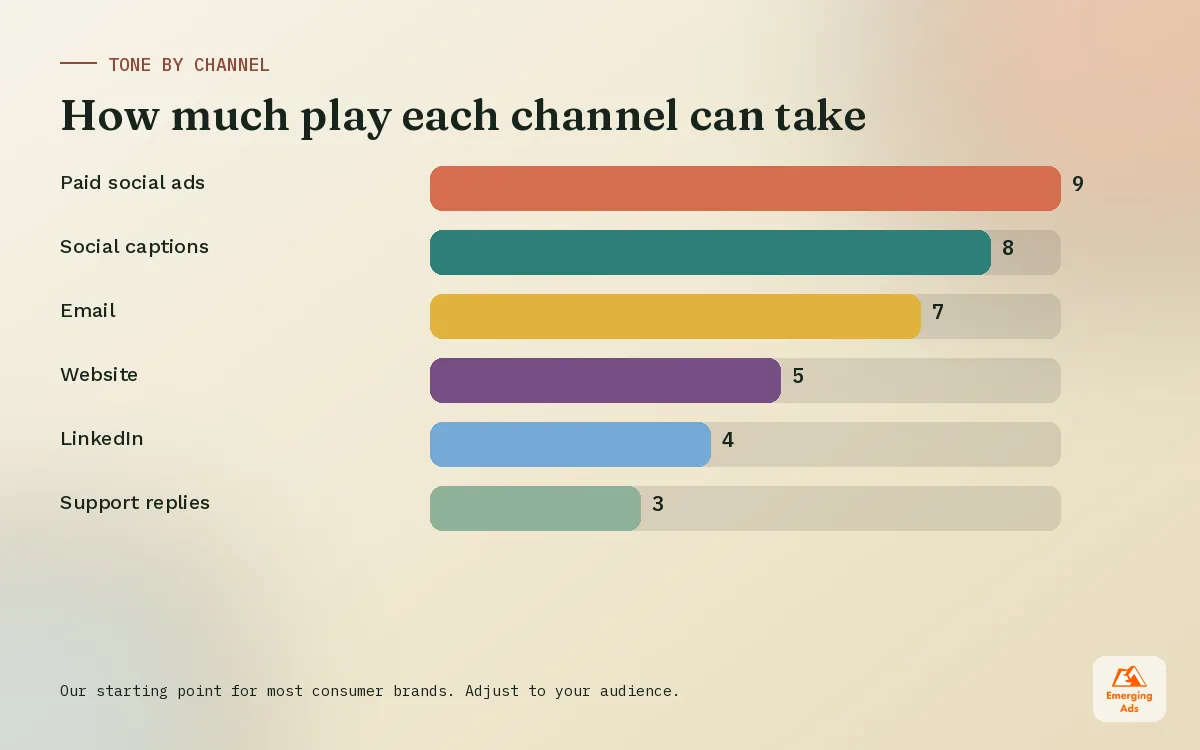
Once voice is set, tone adjusts by channel and situation. A simple way to manage this is a tone slider for each channel, running from playful to serious and from casual to formal.
- Paid social ads: the most playful and punchy. Short lines, strong hooks, conversational.
- Website: clear and confident. Slightly more considered, because people are comparing options.
- Email: personal and conversational, like a note from someone who knows the reader.
- Customer support: calm, warm and plain. Humour steps back when someone has a problem.
- LinkedIn: expert and practical. Our LinkedIn content management work leans on founder stories told in the brand voice.
- Search ads: tight and benefit led, since you only have a few characters on Google Ads.
07Keeping brand voice consistent as you grow
Voice drifts the moment more people start writing. New hires, freelancers, agencies and AI tools all pull it in different directions. A few habits keep it steady.
- Put the voice chart where people write. Pin it in your project tool, your shared drive and your content brief template.
- Build a swipe file. Save the ads, emails and posts that nailed the voice, so new writers can learn from real examples.
- Review, do not rewrite. One person should give voice feedback on important pieces, with comments tied to the chart.
- Brief AI tools properly. If your team uses AI to draft, give it the voice chart and examples. Then edit hard. Unedited AI copy sounds like everyone else.
- Check it quarterly. Read a sample of recent content side by side and see where it drifted.
This is a big part of what our social media management and content strategy teams do week to week: making sure dozens of pieces of content still sound like one brand.
08Brand voice by business type
There is no single right voice, but some patterns fit certain categories better than others. Use these as starting points, then push further to stand apart from your direct competitors.
| Business type | Voice that often works | What to watch for |
|---|---|---|
| Clinics and healthcare | Calm, clear, reassuring, precise | Never make light of symptoms or results. Plain language builds trust. |
| Law and finance | Confident, direct, human | Formal does not have to mean stiff. Explain terms simply. |
| DTC beauty and wellness | Warm, specific, lightly playful | Avoid claims you cannot prove. Let results and reviews speak. |
| Fitness and sport | Energetic, honest, motivating | Shouting in capitals gets old. Real stories beat slogans. |
| SaaS and B2B | Expert, practical, a little dry | Jargon hides value. Name the problem the way users describe it. |
| Restaurants and hospitality | Sensory, friendly, local in feel | Keep it short. Menus and captions are read in seconds. |
Regulated categories deserve extra care. If you work in healthcare marketing or finance, your voice still matters, but every claim needs a second check against the rules in your market.
Voice for founders and personal brands
Founder-led brands have an advantage: the voice already exists in the founder’s own speech. Record them talking about the business for an hour, transcribe it, and pull out the phrases they repeat. That becomes the backbone of the voice chart. The goal is to sound like the founder on a good day, not like a polished corporate version of them.
09How to brief writers, agencies and freelancers on your voice
Most voice problems start at the brief. A writer who receives a topic and a word count will produce something competent and generic. A writer who receives your voice chart, three examples and a clear picture of the reader will produce something that sounds like you.
- Share the voice chart and word list before any work starts, not after the first draft misses.
- Include three pieces that nailed the voice and one that did not, with a short note on why.
- Describe the reader in one paragraph, including what they already know and what they are worried about.
- Give feedback against the chart. “This line is formal, not direct” is useful. “Make it pop” is not.
- Keep a running log of edits. Patterns in your edits show where the chart needs more detail.
This is the same process we use internally when several people write for one client across ads, email and social. It keeps the brand sounding like one person even when five people are typing.
10Common brand voice mistakes
- Adjectives everyone shares. Friendly, professional and innovative describe almost every company. Use contrasts instead.
- Copying a famous brand. Borrowing someone else’s cheeky voice makes you sound like a tribute act.
- Forgetting the customer. Voice exists to help the reader, not to entertain the marketing team.
- Overdoing personality. Jokes in every line get tiring. Personality works best as seasoning.
- Ignoring support and sales. Those are the moments customers remember most.
If you want a second pair of eyes on how your brand sounds today, our branding and content service includes a voice audit across ads, site and email. You can also book a free audit and we will flag the biggest gaps between your ads and your landing pages. For design fundamentals that pair with your voice, read our logo design guide, or see how we help growing B2C brands turn voice into sales.
Frequently asked questions
Straight answers to what clients ask us most about brand voice.
What is brand voice?
What is the difference between brand voice and tone?
How do I find my brand voice?
How many voice traits should a brand have?
What is a brand voice chart?
Can brand voice improve ad performance?
Should brand voice be formal or casual?
How do I keep brand voice consistent with AI writing tools?
How long should a tone of voice guide be?
Does brand voice apply to customer support?
When should I update my brand voice?
Does your ad copy sound like you, or like everyone else?
We will review your ads, landing pages and emails for voice consistency and send back specific rewrites you can test straight away.
Book your free audit