Brand Strategy: The Practical Guide We Hand to New Clients
Most brand strategy documents end up in a shared drive nobody opens. This is the version we actually use with clients, built to change how your ads, website and sales calls perform.
Key takeaways
- Brand strategy is a set of decisions about who you serve, what you stand for and why you win. Logos and colours come after it, not before.
- A useful strategy fits on two pages and settles arguments. If your team still debates the headline on every ad, the strategy is not finished.
- Our 7-part framework runs from business goal to activation, and the whole thing can be built in about 30 days with the right inputs.
- The fastest proof that a strategy works shows up in paid media: clearer hooks, better click-through and lower cost per lead.
- Review it every quarter against real customer language, not every time a competitor launches something shiny.
01What brand strategy actually is (and what it is not)
When a founder tells us they need a brand strategy, they usually mean one of three things. They want a new look, they want a clearer message, or they have noticed that their marketing feels scattered and nobody can explain why. Only the second and third are strategy problems. The first is a design brief, and it goes much better once the strategy exists.
Here is the plain definition we use: brand strategy is the set of choices that decides who you are for, what you promise them, and why they should believe you over the alternatives. It is a decision document. It is not a mood board, a mission statement on a wall, or a 60-slide deck full of adjectives.
A good test is whether the strategy helps someone make a call they would otherwise argue about. Should the next campaign lead with price or with craftsmanship? Should you sponsor that event? Is this new product line on brand? If the document answers those questions quickly, it is doing its job. If it only describes the brand in flattering words, it is decoration.
Brand strategy vs marketing strategy
The two get mixed up constantly. Marketing strategy decides channels, budgets and campaigns for a period of time. Brand strategy sits underneath and changes far less often. Your marketing plan for Q4 might be heavy on Meta ads and email, while your brand strategy says you are the careful, expert option for buyers who have been burned before. The plan changes every quarter. The position should hold for years.
02Why brand strategy changes your ad results
We run paid media for a living, so we look at brand through a practical lens. Our view is simple: a weak brand makes every advertising pound work harder than it should. The ad has to introduce you, explain you, and persuade in three seconds. A clear brand lets the ad skip the first two jobs.
In practice, the difference shows up in a few places we measure every week on client accounts:
- Hook strength. When the positioning is sharp, the opening line of a video or the headline of a static writes itself. Creative testing gets faster because you are testing angles of one idea, not five unrelated ideas.
- Click-through rate. Specific promises beat generic ones. “Skincare for reactive skin, tested on reactive skin” earns attention that “clean, effective skincare” never will.
- Conversion rate after the click. If the ad and the landing page tell the same story, fewer people bounce. We see this on almost every conversion rate optimisation project we take on.
- Branded search. Over time, a distinctive brand gets searched by name. That traffic is cheap on Google Ads and often converts at several times the rate of generic keywords.
None of this needs a large budget. We have seen small brands with a clear point of view outperform competitors spending far more, simply because their message was easier to remember.
03The 7-part brand strategy framework we use
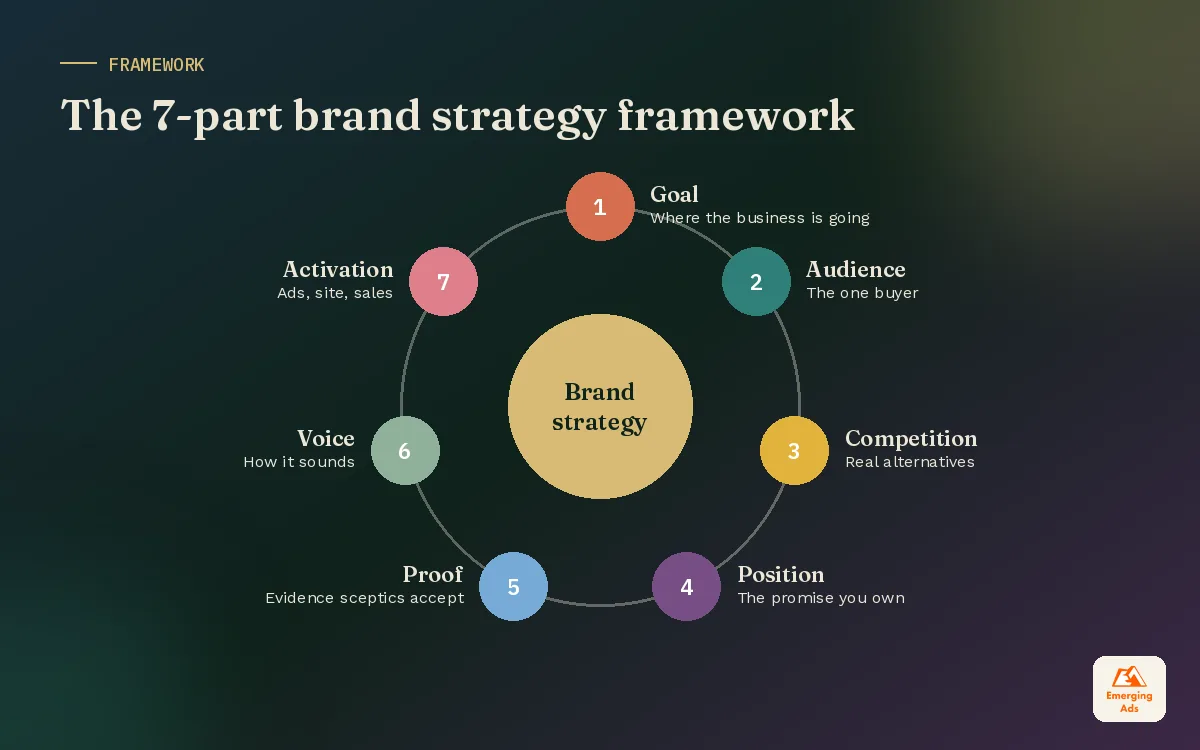
Frameworks are only useful if they are short enough to remember. Ours has seven parts, and each one produces a written answer of a few sentences. The whole document usually lands at two pages.
1. Business goal
Start with what the business needs in the next two to three years. Growing into a new category, raising prices, entering retail, or getting acquired all call for different brand choices. A brand built to sell premium subscriptions should not look or sound like one built for volume discounting.
2. Audience
Pick the buyer you are designing for. Not a demographic range, a real person with a situation. We build this from sales call recordings, customer reviews, support tickets and the search terms in your ad accounts. The words your customers use become the raw material for your messaging, which is why this part matters so much for content strategy later on.
3. Competitive frame
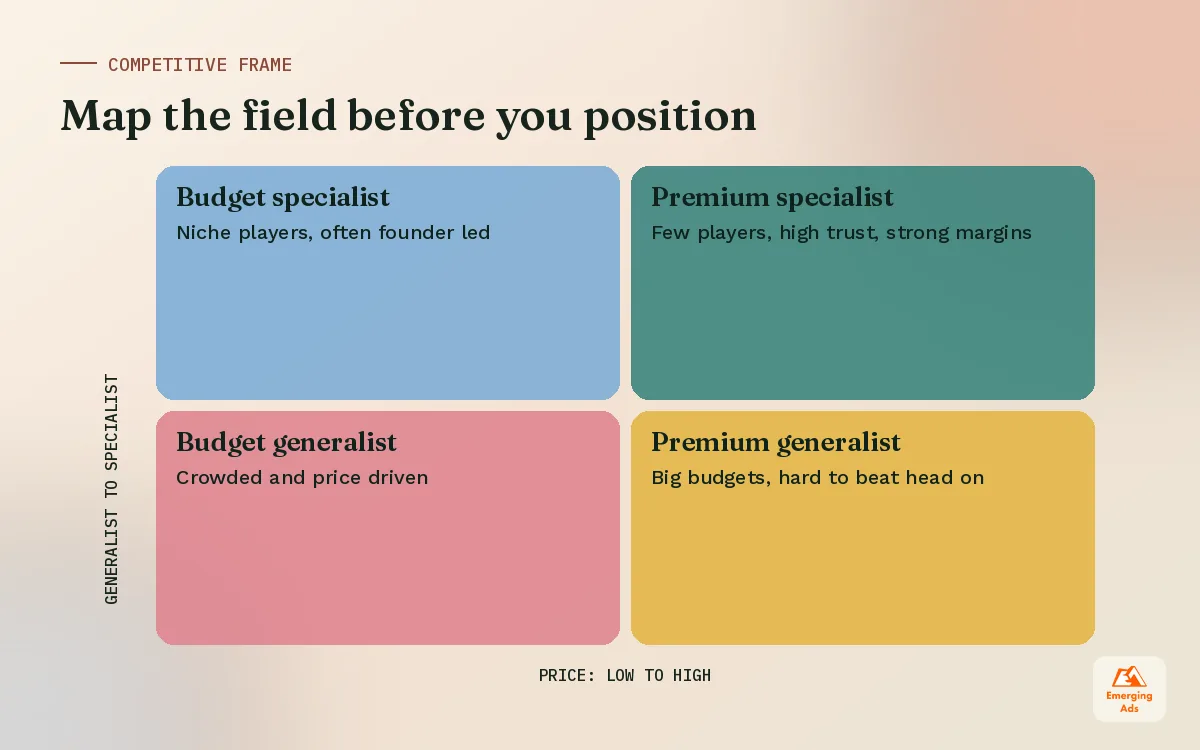
Name the alternatives your buyer is weighing. Often the biggest competitor is not another brand but doing nothing, doing it themselves, or sticking with a familiar option. You cannot position against a vague field, so list the three to five real alternatives and write down what each one is known for.
4. Positioning
This is the core sentence: for this audience, you are the option that delivers this specific outcome, because of this reason to believe. We go deeper on the wording in our companion piece on brand positioning, but the key is that it must be something you can defend and a competitor cannot easily copy.
5. Proof
Every claim needs evidence a sceptic would accept. Reviews, before and after results, certifications, guarantees, founder credentials, case studies. List them, rank them, and note which claims you cannot yet prove so you stop making them. Our client success stories page exists for exactly this reason.
6. Personality and voice
Describe how the brand behaves using contrasts, not single adjectives. “Confident, not arrogant” is useful. “Confident” alone is not, because everyone thinks they are confident. Add two or three example sentences written the right way and the wrong way.
7. Expression and activation
Finally, translate the decisions into the places people meet you: your visual identity, your website, your ads, your social feed, your sales deck. This is where a brand identity design project begins, with a brief that is already settled rather than a blank page.
04How to build a brand strategy in 30 days
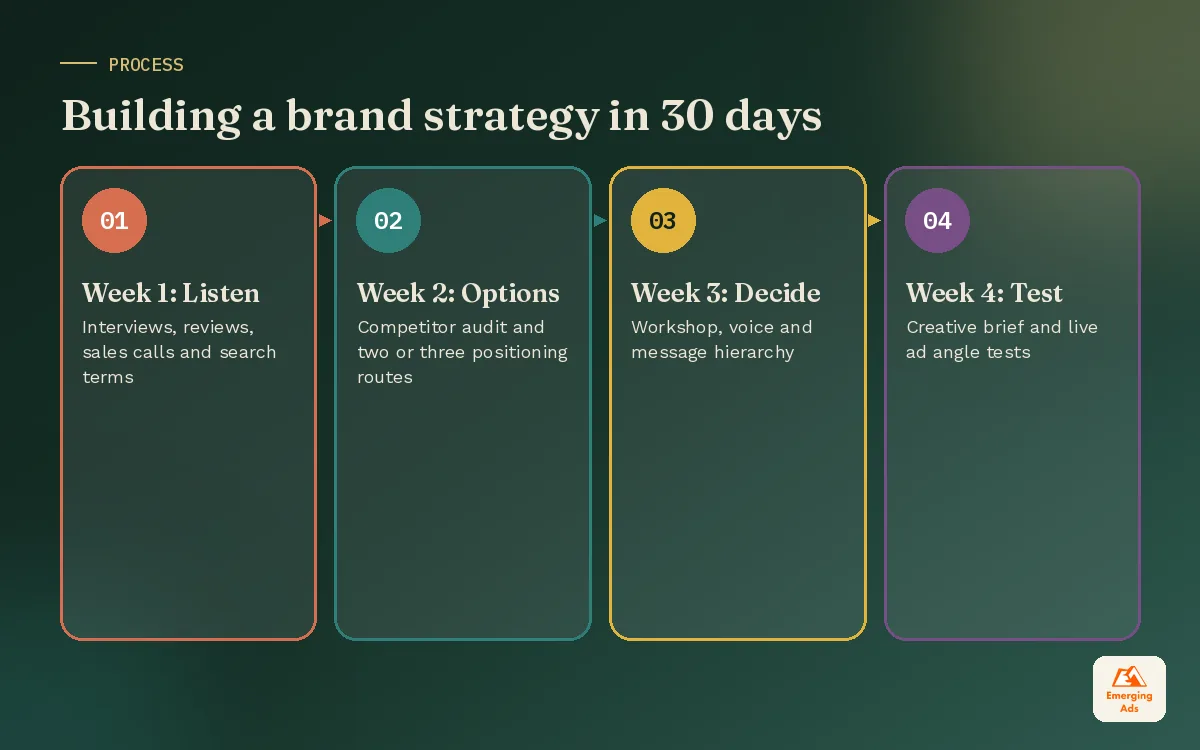
Most of the delay in brand projects comes from waiting on inputs and from meetings where nobody is ready to decide. When we run a strategy sprint, we front-load the research and keep decision meetings short. Here is the plan we follow.
| Week | What happens | Output |
|---|---|---|
| Week 1 | Stakeholder interviews, 6 to 10 customer calls, review mining, ad account and search term analysis | Research summary with direct customer quotes |
| Week 2 | Competitor audit, positioning options, first draft of audience and proof sections | Two or three positioning routes to choose from |
| Week 3 | Decision workshop, voice and personality, message hierarchy | Signed-off strategy document, two pages |
| Week 4 | Creative brief for identity, ad angle tests, homepage headline tests | Brief plus first live tests in paid social |
The last week is the one most agencies skip, and it is the one that matters. We like to put two or three positioning angles into small paid tests on Meta before the design work starts. Real click and conversion data is a far better tiebreaker than a boardroom vote.
Inputs to gather before you start
- Your last 50 to 100 customer reviews, good and bad
- Recordings or notes from at least five recent sales calls
- Search term reports from Google Ads and any organic keyword data you have
- Your top three competitors’ homepages, ads and pricing
- A short list of what the founders refuse to become, which is often more revealing than what they want
05Brand strategy examples by business type
Strategy looks different depending on how a business sells. These are simplified versions of patterns we see across client work. They are illustrations of the thinking, not templates to copy word for word.
| Business type | Typical trap | Stronger strategic choice |
|---|---|---|
| DTC skincare | Competing on ingredient lists everyone shares | Own a specific skin situation and prove results for it |
| B2B service firm | Listing every service to look big | Lead with one painful problem and a named method for solving it |
| Local clinic | Generic trust language | Specific doctor credentials and a visible, simple patient process |
| Fitness studio | Selling features like equipment and classes | Selling identity and community, then backing it with results |
| SaaS startup | Describing the product, not the outcome | Naming the old way and positioning against it |
Notice that none of the stronger choices are about colour or fonts. Those come later. If you want to see how this plays out in a full rebrand, our main site covers when a rebrand is actually worth it in more detail.
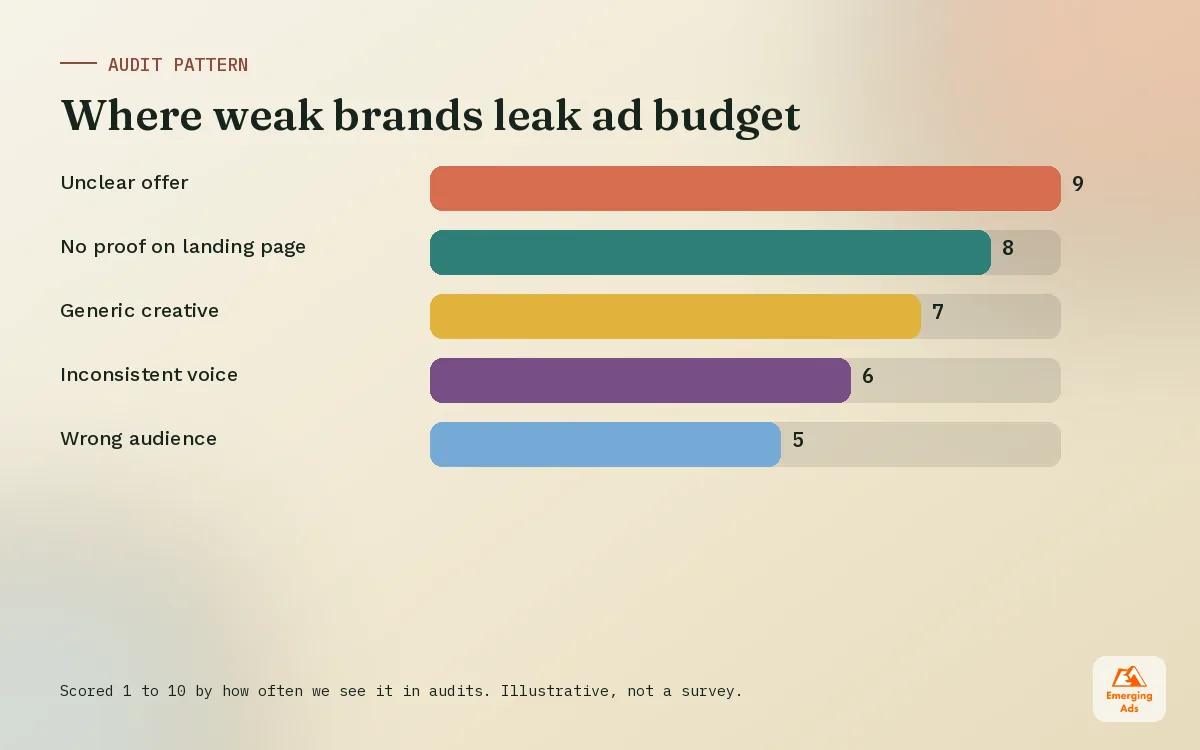
06Common brand strategy mistakes we fix in audits
When we audit a brand before taking over its paid media or social media management, the same problems come up again and again.
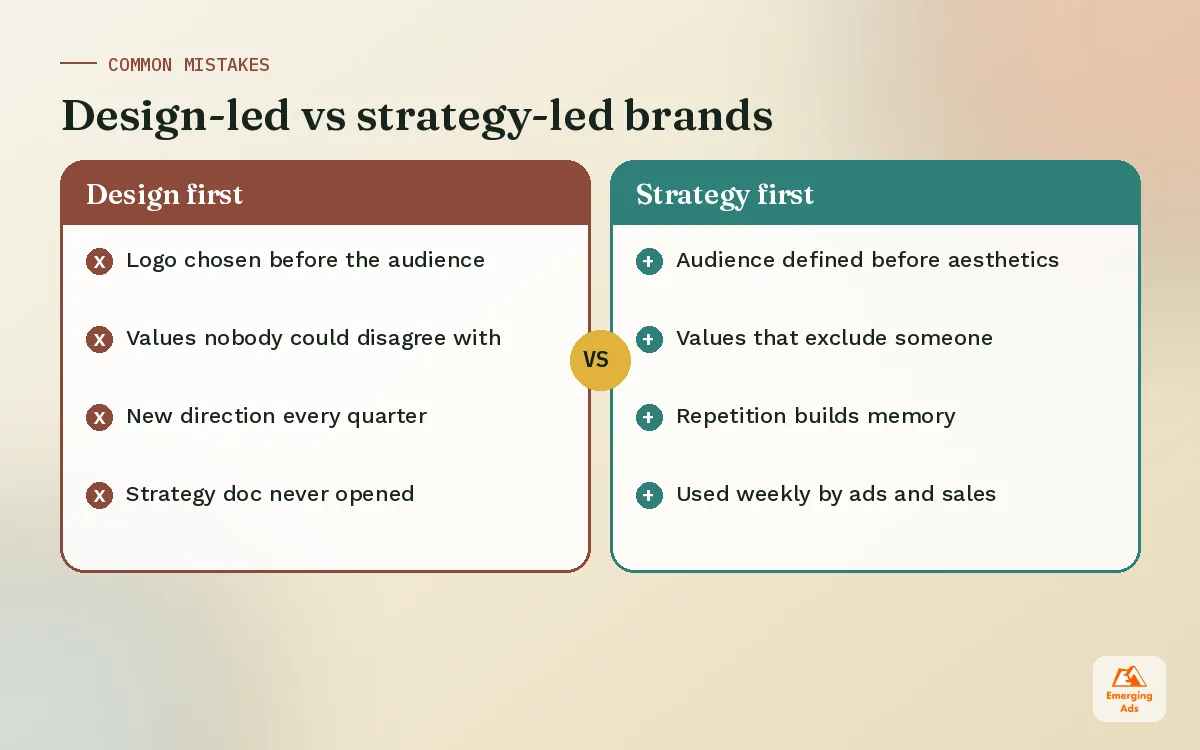
- Trying to appeal to everyone. A broad audience feels safe but produces bland messaging. Bland messaging is expensive to advertise.
- Values nobody can disagree with. Integrity, quality and innovation describe almost every company. Pick values that exclude someone.
- Strategy written but never used. If the ad team, the website copywriter and the sales team have never read it, it does not exist.
- Starting with the logo. Visual identity built without a strategy tends to get redone within two years because nobody can explain why it looks the way it does.
- Ignoring what customers actually say. The best positioning lines we have ever written were adapted from a customer review, not invented in a workshop.
- Changing direction every quarter. Brands build memory through repetition. Constant pivots reset that memory to zero.
If your strategy does not make you say no to something, it is not a strategy yet.
07How to measure whether your brand strategy is working
Brand work has a reputation for being hard to measure. It is harder than measuring a single campaign, but it is far from impossible. We track a mix of leading and lagging signals.
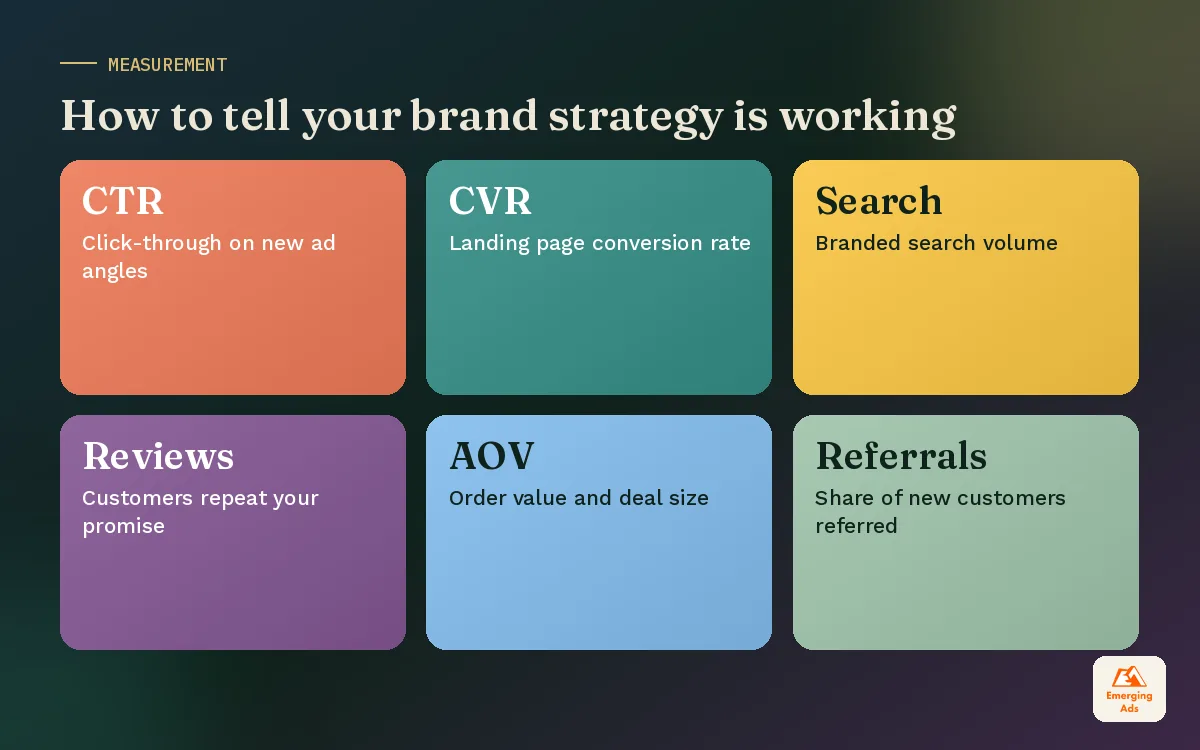
- Leading signals (weeks): ad click-through rate on new angles, landing page conversion rate, time on page, reply rate on outbound emails that use the new messaging.
- Middle signals (months): branded search volume, direct traffic, share of reviews that repeat your key promise back to you, sales cycle length.
- Lagging signals (quarters): average order value or deal size, price resistance in sales calls, repeat purchase rate, referral share of new customers.
Set a baseline before the new strategy goes live. A clean GA4 setup and consistent reporting make this much easier, because you can compare like for like rather than guessing.
08When to bring in outside help
You can build a solid brand strategy in-house if someone senior owns it and has the time to do the research properly. Outside help earns its fee in three situations: when the founders are too close to the product to see it the way buyers do, when internal politics make hard choices difficult, or when you need the strategy to connect directly to performance marketing without a handover gap.
That last point is why we built our branding and content service next to our paid media team rather than as a separate studio. The same people who write the positioning also see the ad data every week, so the strategy gets tested in the market instead of being admired in a presentation. If you are weighing options, our guide to choosing a digital marketing agency covers the questions worth asking.
Whatever route you take, start small. Write the two-page version, test it in your ads and on your homepage, and refine it with real numbers. You can read more about how we approach this on the wemergingads.com homepage, or look at the full list of EmergingAds services to see how brand work connects to the rest of the funnel.
Frequently asked questions
Straight answers to what clients ask us most about brand strategy.
What is included in a brand strategy?
How long does it take to create a brand strategy?
How much does a brand strategy cost?
Do small businesses need a brand strategy?
What is the difference between brand strategy and brand identity?
Can I write my own brand strategy?
How often should a brand strategy be updated?
How does brand strategy affect paid advertising?
What is a brand strategy framework?
What are good brand strategy examples?
Who should be involved in building a brand strategy?
Not sure your brand is pulling its weight in your ads?
We will review your positioning, creative and landing pages side by side and show you where the message breaks. No pitch deck, just a clear list of fixes.
Book your free audit