Brand Positioning: The Practical Guide We Hand to New Clients
Positioning is the decision that makes the rest of your marketing easier. Get it right and your ads, website and sales calls all tell the same sharp story. Here is the method we use with clients.

Key takeaways
- Positioning is the place your brand owns in a buyer’s mind compared with the alternatives they are weighing.
- It is built from three inputs: a specific audience, a meaningful difference and proof you can back up.
- Write a positioning statement for internal use, then translate it into headlines customers actually read.
- Test positioning angles in paid ads before you redesign anything. Real behaviour beats boardroom opinion.
- Strong positions exclude someone. If everyone could agree with it, it is not sharp enough.
01What brand positioning actually means
Brand positioning is the specific place you want to hold in your buyer’s mind, relative to the other options they are considering. It answers a simple question: why should this person choose you over the alternatives, including doing nothing?
Positioning is one part of a wider brand strategy, but it is the part that does the most work. It shapes your headlines, your offer, your pricing, your visual identity and how your sales team opens a call. When positioning is fuzzy, every one of those becomes an argument.
Positioning is not what you do to a product. It is what you decide to be famous for.
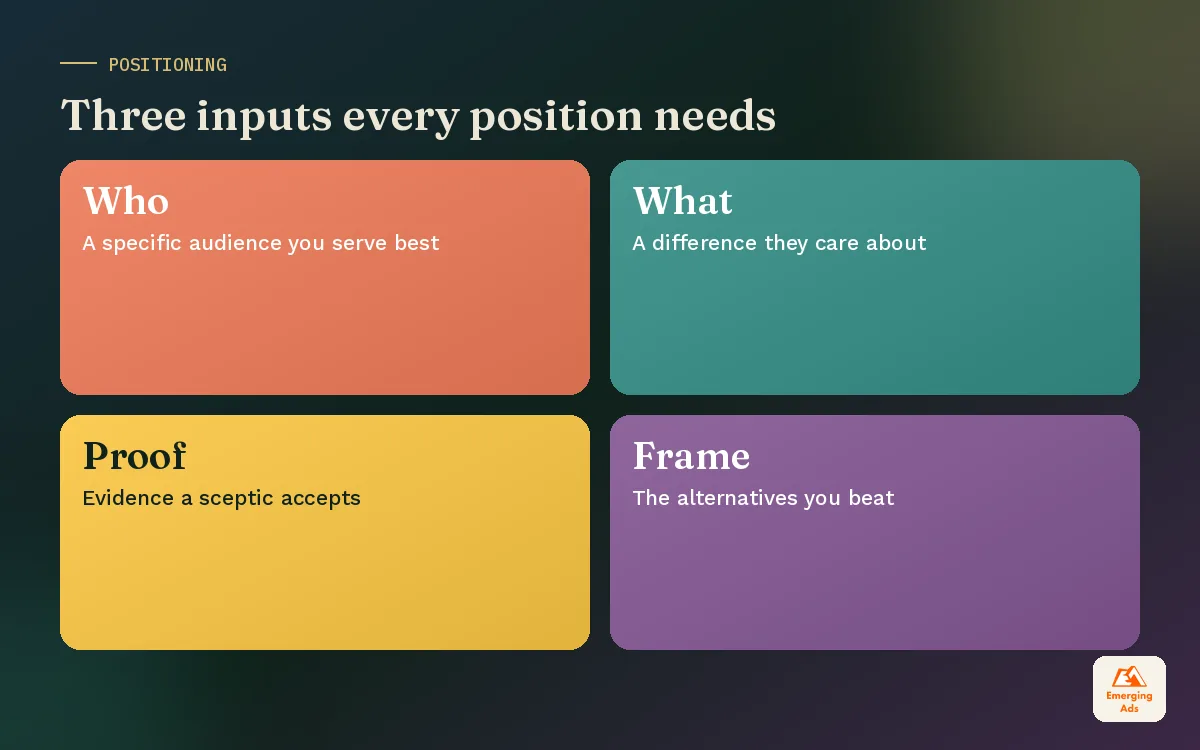
02The three inputs every position needs
1. A specific audience
You cannot be the best choice for everyone. Pick the buyer for whom your offer is clearly the best fit. The narrower the audience, the easier it is to sound like the obvious choice. You can expand later from a position of strength.
2. A meaningful difference
Find what you do differently that this audience actually cares about. It might be a method, a speciality, a guarantee, a speed, a price model or a point of view. The difference has to matter to the buyer, not just to you.
3. Proof
A position without proof is a slogan. Results, reviews, credentials, case studies and demonstrations turn claims into beliefs. If you cannot prove a difference yet, it is an aspiration, not a position.
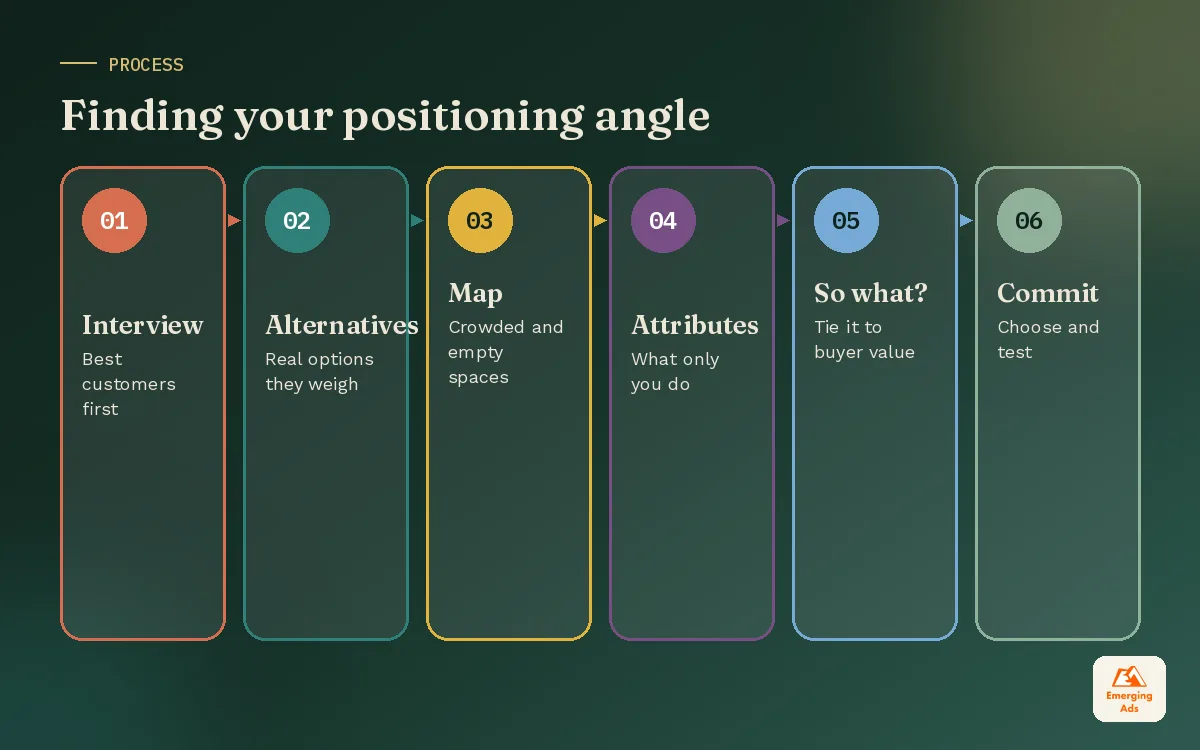
03How to find your positioning angle
Positioning is found, not invented. The raw material is already in your business, your customers and your market. This is the process we follow.
- Interview your best customers. Ask what they were trying to do, what else they considered and why they chose you. Look for surprising answers.
- List the real alternatives. Competitors, DIY, hiring in-house, doing nothing. Write down what each is known for.
- Map the field. Plot competitors on two dimensions that matter to buyers, such as price and specialisation. Look for crowded corners and empty spaces.
- List your unique attributes. Everything you do that alternatives do not, from method to guarantee to team background.
- Connect attributes to value. For each attribute, ask “so what?” until you reach something the buyer genuinely cares about.
- Choose and commit. Pick the angle where your strongest difference meets the audience that cares about it most.
04Types of positioning strategies
Most strong positions fall into a handful of patterns. Knowing them helps you spot options faster.
| Strategy | How it works | Example pattern |
|---|---|---|
| Specialist | Own one audience, problem or niche deeply | The accountants for creative studios |
| Method | Own a named process or approach | A three-step system with a clear name |
| Challenger | Position against the category norm | No contracts, no hidden fees, no jargon |
| Premium | Own quality, craft or exclusivity | Made in small batches, limited availability |
| Value | Own the smartest price for good quality | Everything you need, nothing you do not |
| Speed or convenience | Own the fastest or easiest option | Live in a week, not a quarter |
In regulated or trust-heavy categories such as healthcare and real estate, specialist and method positions tend to work especially well, because buyers want confidence that you have done this many times before.
05Writing a brand positioning statement
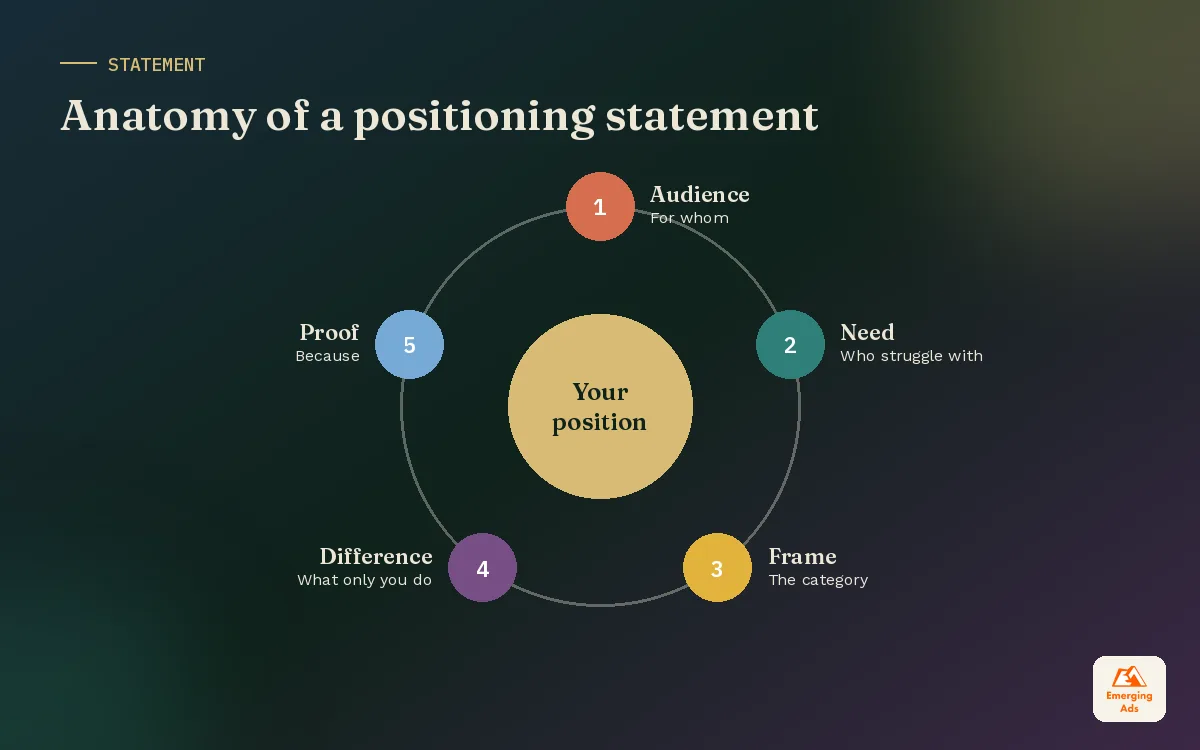
The positioning statement is an internal tool. Customers will never read it. Its job is to keep the team aligned and to act as a filter for every marketing decision.
A simple template we use:
An illustrative example for a fictional brand: “For busy clinic owners who are tired of agencies that report clicks instead of patients, Clinicgrow is the patient acquisition partner that reports booked appointments every week, because every campaign is tracked from ad to calendar.”
Notice how specific it is. It names the audience, the frustration with the alternatives, the difference and the proof. Now every ad, page and email can be checked against it.
06Turning the statement into customer-facing messaging
Once the statement is agreed, translate it into language customers actually read. This is where your brand voice comes in.
| Where | What it should do | Example direction |
|---|---|---|
| Homepage headline | State the difference in plain words | Patients booked, not clicks reported |
| Ad hooks | Hit the frustration fast | Tired of reports full of clicks? |
| Landing page | Back the claim with proof | Weekly booked appointment reports, with real screenshots |
| Sales call opener | Frame the conversation | Most clinics we speak to have been burned by vanity metrics |
| Social bio | Summarise the position in one line | Patient acquisition for clinics, measured in bookings |
Consistency across these touchpoints is what makes positioning stick. When the ad and the landing page say the same thing, conversion rates usually improve. This is one of the first things our CRO team checks.
07Testing positioning in paid ads
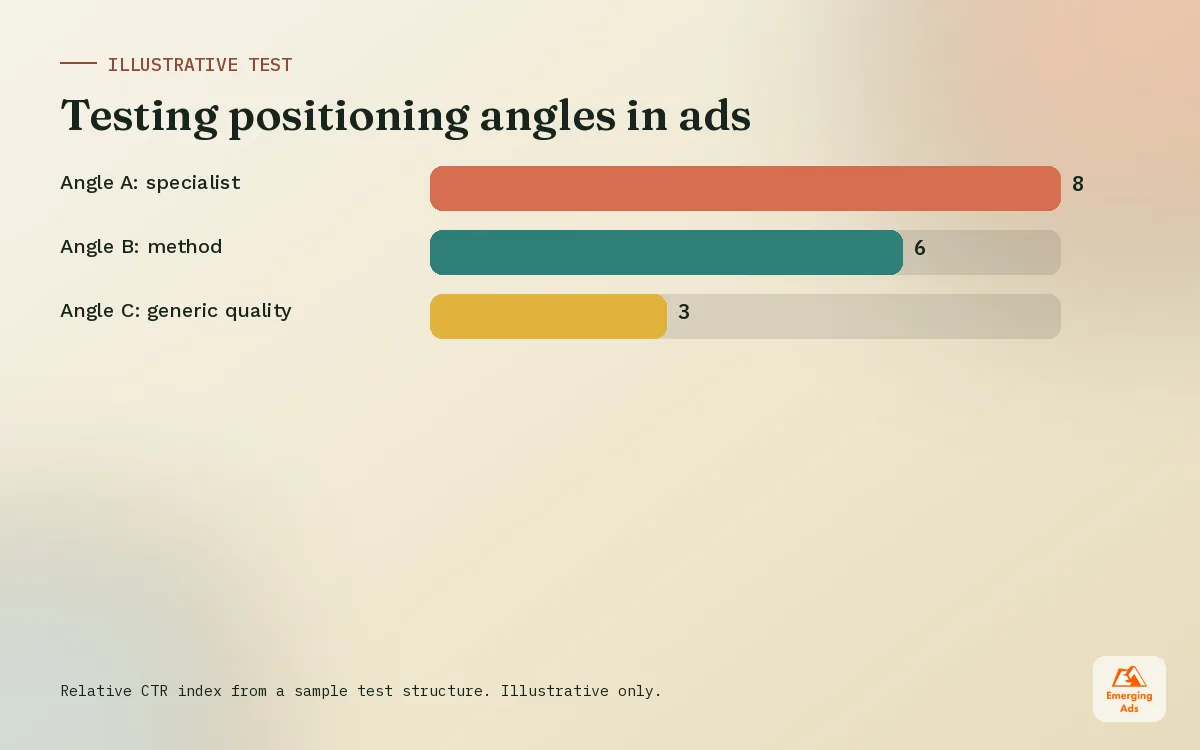
Here is the part most positioning projects skip. Before redesigning your website or printing anything, test two or three positioning angles in paid social and search.
- Write one ad per angle, keeping visuals and format the same so the message is the main variable.
- Run them to the same audience on Meta ads with equal budgets for one to two weeks.
- Mirror the test in search with different headlines on Google Ads where volume allows.
- Compare click-through, cost per lead and lead quality, not just clicks.
- Listen to comments and replies. They often reveal which angle people actually believe.
This test costs a fraction of a rebrand and replaces opinion with evidence. We run it for most new branding clients before any design work begins. Positions that win in testing also make excellent foundations for brand awareness campaigns.
08Brand positioning examples by category
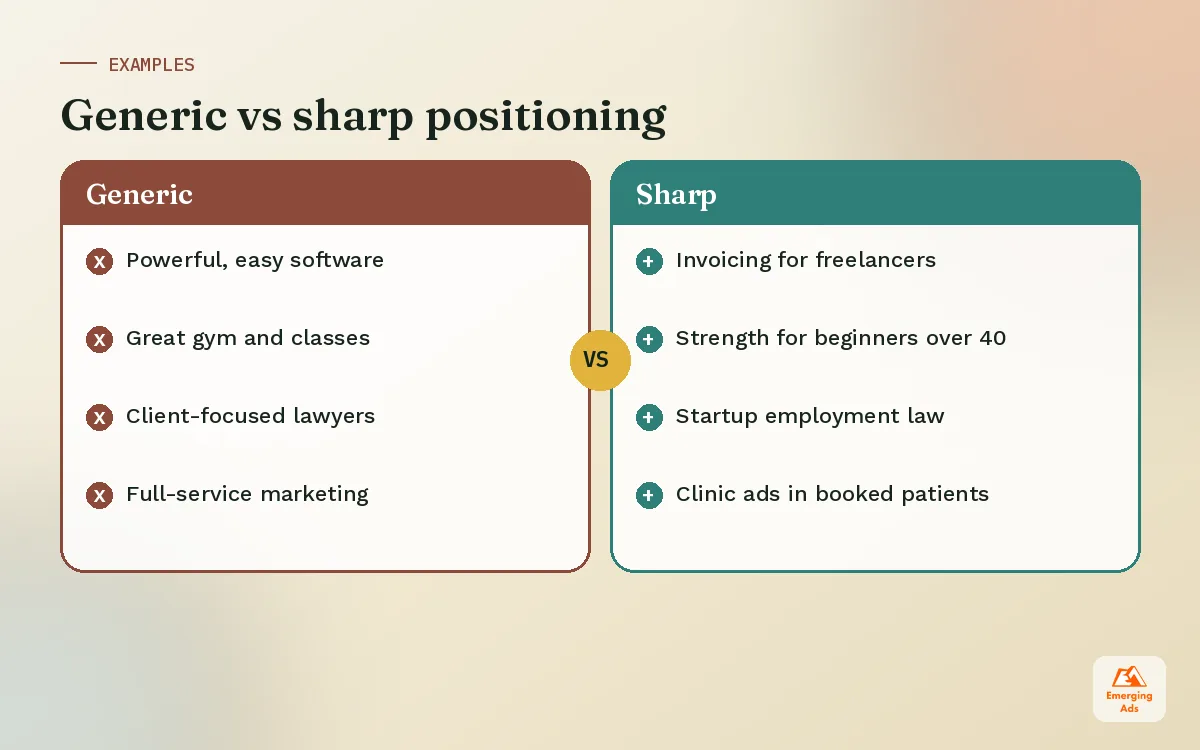
These are illustrative patterns rather than real brand claims, showing how a generic position becomes sharper.
| Category | Generic position | Sharper position |
|---|---|---|
| SaaS tool | Powerful, easy-to-use software | Invoicing built for freelancers who hate admin |
| Fitness studio | State-of-the-art gym with great classes | Strength training for beginners over 40 |
| Law firm | Experienced, client-focused lawyers | Employment law for startups, fixed-fee packages |
| Skincare brand | Clean, effective skincare for everyone | Barrier repair for skin that reacts to everything |
| Marketing agency | Full-service digital marketing | Paid media for clinics, reported in booked patients |
Each sharper version excludes people. That is the point. The brands we see growing fastest are rarely the ones trying to please everyone. If you sell software, our SaaS campaign management work shows how a sharp position changes acquisition costs.
09How positioning shapes pricing, offers and sales
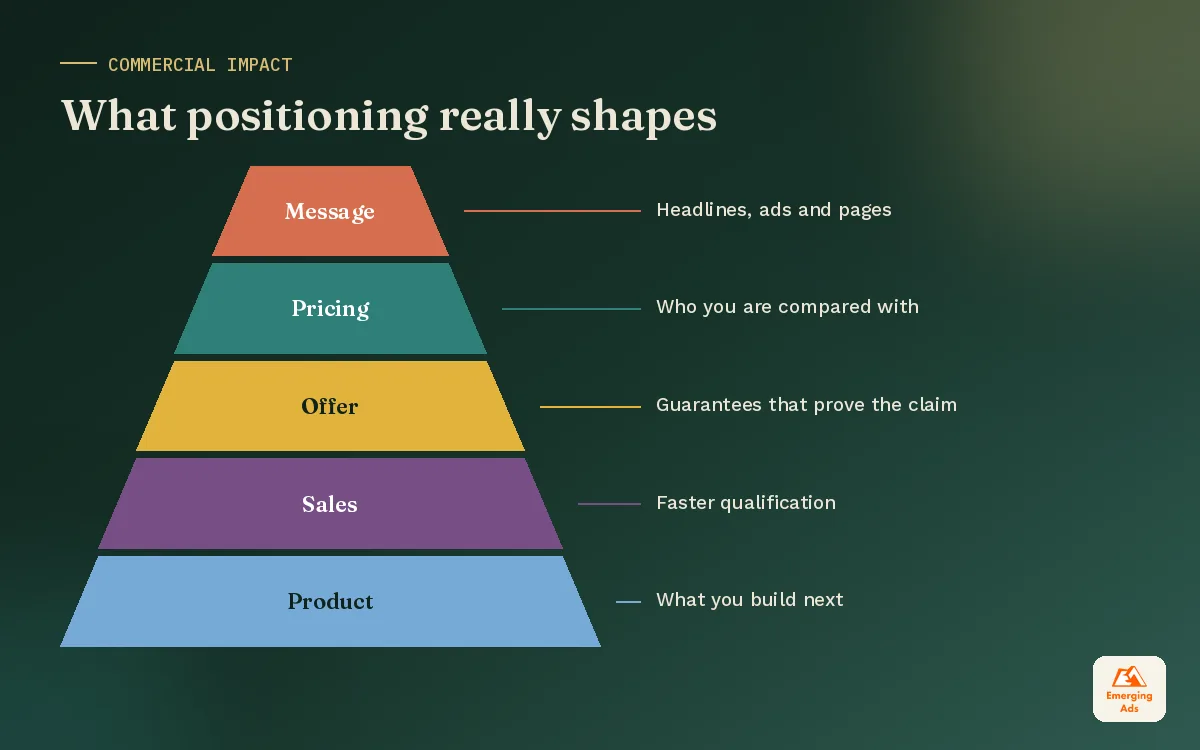
Positioning is often treated as a messaging exercise, but its biggest effects show up in the commercial side of the business. Once you know the space you own, several hard decisions become easier.
Pricing
A specialist or premium position supports higher prices, because buyers compare you with fewer alternatives. A value position needs a cost structure that can sustain lower margins. Many brands that complain about price pressure are really suffering from a weak position that invites comparison with everyone.
Offers
Your offer should prove the position. A brand positioned on speed might offer a guaranteed launch date. A brand positioned on transparency might publish its pricing openly. An offer that contradicts the position, such as a premium brand running constant discounts, slowly erodes it.
Sales conversations
Sales teams with a clear position spend less time explaining and more time qualifying. They can open with the problem the position solves and quickly spot poor-fit leads. That tends to shorten sales cycles and raise close rates.
Product and service decisions
New services, features or product lines should strengthen the position, not blur it. A useful question before launching anything new is whether it makes you more or less clearly the best choice for your core audience.
10Repositioning an existing brand
Sometimes the position you have is not the one you need. Markets shift, new competitors arrive, or the business grows into a different audience. Repositioning is possible, but it takes more care than positioning a new brand, because people already hold a picture of you.
- Start from what customers already believe. Build the new position as a step from the old one where you can, rather than a jump.
- Change the proof first. New case studies, offers and product changes make the new position believable before you announce it.
- Update every touchpoint together. A new homepage with old ads and old sales scripts confuses everyone.
- Tell existing customers directly. Explain what is changing and why it helps them.
- Give it time. Perceptions move slowly. Measure over quarters, not weeks.
If the change is large, it may be part of a wider rebrand. Our main site covers when a rebrand is worth it and how to avoid losing the recognition you already have.
11Positioning mistakes that keep brands forgettable
- Claiming what everyone claims. Quality, service and innovation are table stakes, not positions.
- Positioning on features competitors can copy. Features change. Positions should last.
- Being too broad out of fear. Narrow positions feel risky but usually grow faster.
- No proof. Claims without evidence erode trust quickly.
- Changing position every campaign. Memory needs consistency.
- Letting the logo lead. Visual identity should express the position, not define it. That order is why our brand identity design work always starts from positioning.
If you are weighing whether to do this in-house or with a partner, our guide to choosing a digital marketing agency covers the questions to ask. Or start with a free audit and we will show you where your current positioning is losing you clicks and sales. For a broader view of what we do, see all EmergingAds services or read our success stories.
Frequently asked questions
Straight answers to what clients ask us most about brand positioning.
What is brand positioning?
What is a brand positioning statement?
How do I write a brand positioning statement?
What are the main types of positioning strategies?
How is positioning different from branding?
How long does it take to define brand positioning?
Can small businesses benefit from positioning?
How do I know if my positioning is working?
Should my positioning exclude some customers?
How often should brand positioning change?
What is repositioning?
Not sure how buyers see you next to competitors?
We will compare your messaging, ads and landing pages against your top competitors and show you where a sharper position could win.
Book your free audit