The Brand Messaging Framework We Hand to New Clients
If five people in your company described what you do, would they say the same thing? A messaging framework makes sure they do, from the homepage to the sales call to the ad that runs tomorrow.
Key takeaways
- A messaging framework turns your positioning into the exact words your team uses everywhere.
- It has five layers: core message, value proposition, message pillars, proof points and audience versions.
- Build it from customer language, then trim until each line is something only you could say.
- Keep it to one or two pages with real example headlines, not abstract descriptions.
- Test the key messages in ads and on landing pages, and update the framework with what wins.
01What a brand messaging framework is
A brand messaging framework is a structured document that defines what your brand says, in what order, to whom. It takes the decisions in your brand positioning and turns them into reusable language for ads, web pages, emails, social posts and sales conversations.
Positioning answers where you stand. Voice answers how you sound. Messaging answers what you actually say. All three need to agree. Your brand voice guide makes sure the framework sounds like you, and your positioning makes sure it says the right thing.
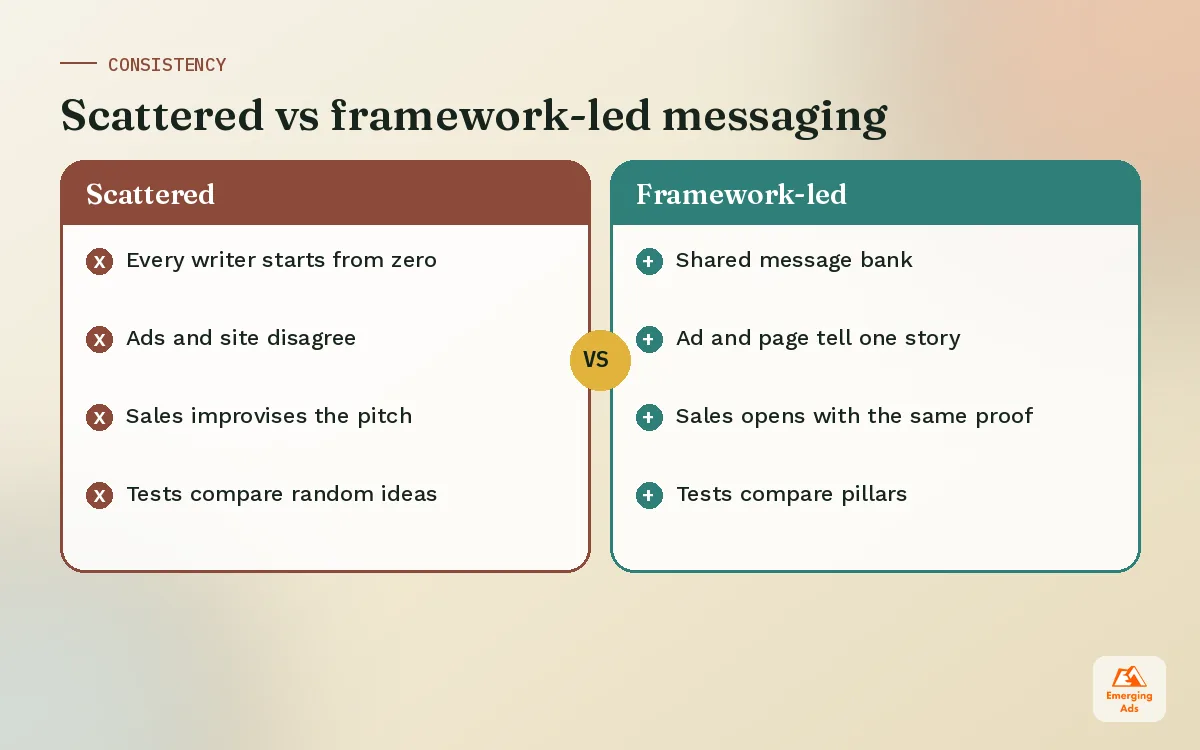
Without a framework, every writer starts from scratch. The website says one thing, the ads say another and the sales team improvises a third. Buyers notice the inconsistency even if they cannot name it, and it quietly lowers trust and conversion rates.
02The five layers of a messaging framework
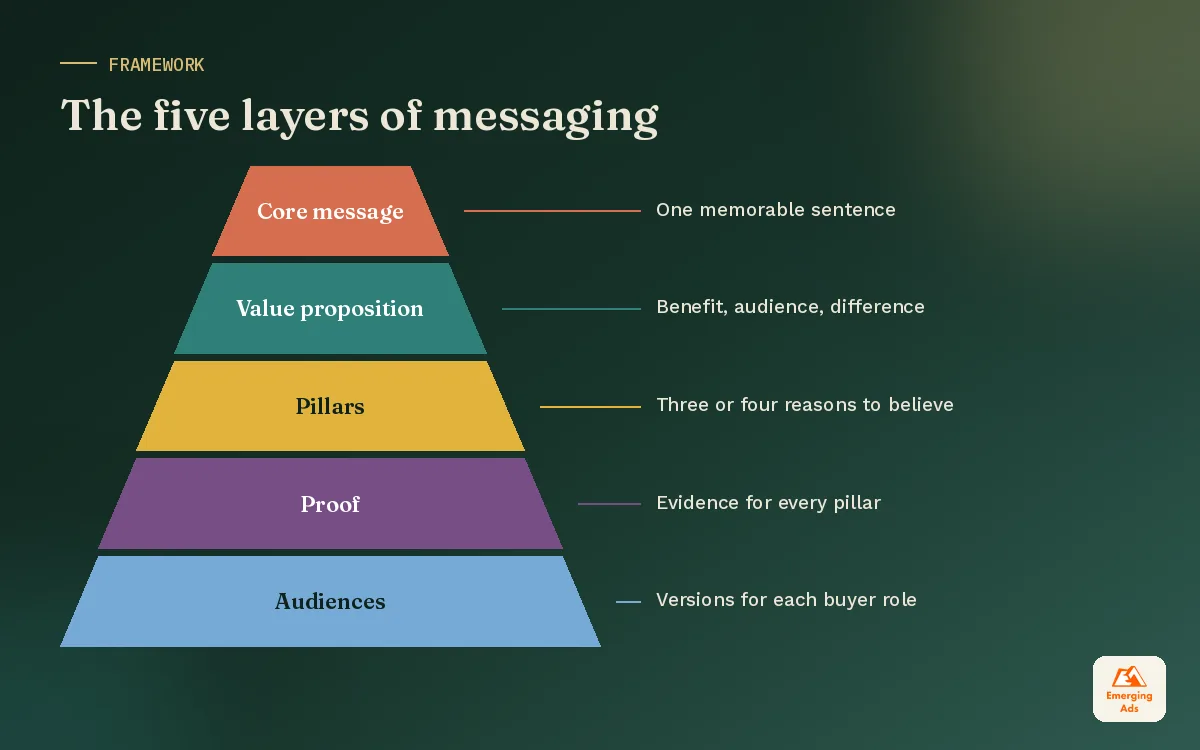
1. Core message
One sentence that captures the heart of what you offer and why it matters. It should be simple enough that anyone in the company can remember it. It is not always customer-facing, but most headlines grow from it.
2. Value proposition
A short statement of the main benefit you deliver, for whom, and how it is different. It usually becomes the homepage headline and subheadline in some form.
3. Message pillars
Three or four supporting themes that explain why the value proposition is true. Each pillar covers one reason to believe, such as your method, your results, your speed or your service model.
4. Proof points
Evidence for each pillar: numbers, case studies, reviews, credentials, guarantees and demonstrations. Every pillar needs at least two pieces of proof, or it is only a claim.
5. Audience versions
Short adaptations of the message for each key audience or buying role. A founder, a marketing manager and a finance lead care about different outcomes from the same product.
03A messaging framework template
This is the one-page structure we use. Fill each cell with real sentences, not notes.
| Layer | What to write | Illustrative example |
|---|---|---|
| Core message | One memorable sentence | Marketing you can measure in booked appointments, not clicks |
| Value proposition | Benefit, audience, difference | Paid media for clinics that reports real patients every week |
| Pillar 1: Method | How you deliver differently | Every campaign tracked from ad to calendar booking |
| Pillar 2: Focus | Why your specialism matters | We only work with clinics, so we know the patient journey |
| Pillar 3: Transparency | How clients stay in control | Weekly reports in plain language, month-to-month terms |
| Proof | Evidence for each pillar | Case studies, dashboard screenshots, reviews, certifications |
| Audience: owner | What they care about | Full diaries and predictable growth |
| Audience: practice manager | What they care about | Less admin and fewer no-shows |
The example uses a fictional clinic marketing firm to show the level of specificity to aim for. Your version should use your customers’ own words wherever possible.
04How to build your messaging framework
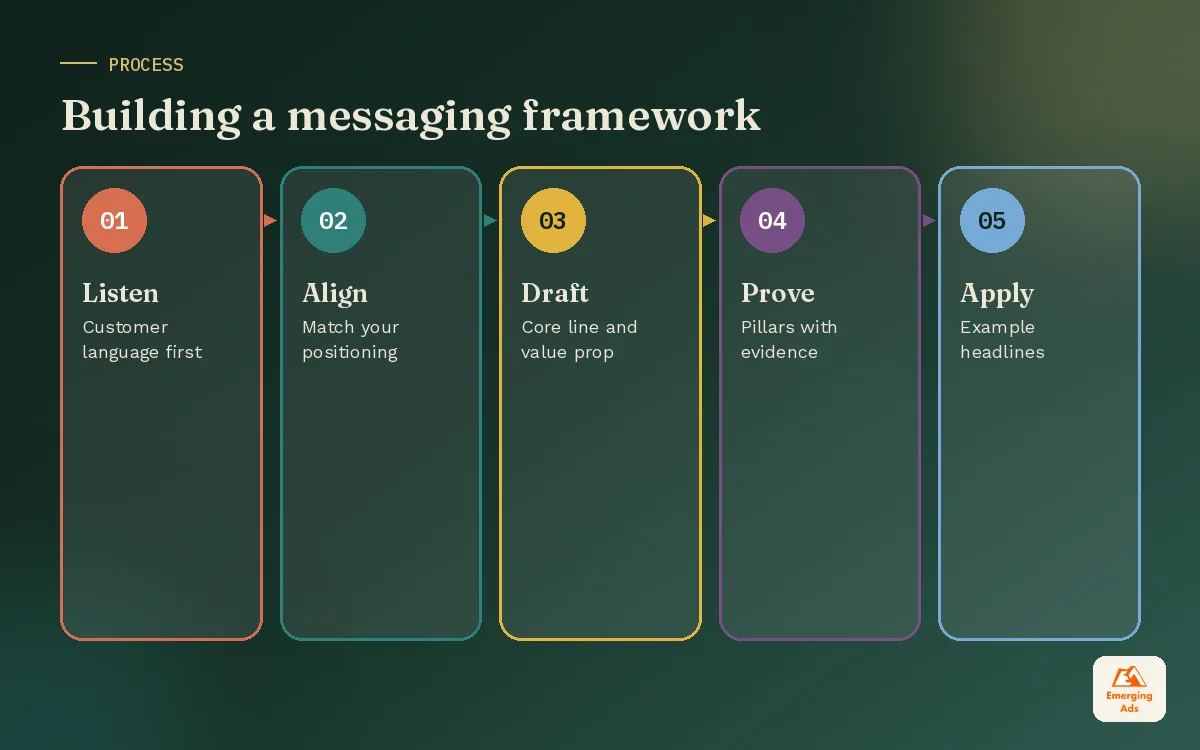
- Gather customer language. Pull phrases from reviews, sales calls, support tickets and search terms. Highlight how people describe the problem, the outcome and why they chose you.
- Start from your positioning. The value proposition must match your position exactly. If they drift apart, fix the positioning first.
- Draft the core message and value proposition. Write ten versions of each, then pick the clearest, not the cleverest.
- Choose three or four pillars. Each must be a real reason to believe, backed by proof. Drop any pillar you cannot prove.
- Collect and rank proof. Put your strongest evidence first. Note gaps so you can create new case studies or reviews.
- Write audience versions. Adapt the benefits for each buyer role or segment without changing the core message.
- Add example headlines. Show how the framework becomes real copy for ads, the homepage and email subject lines.
05Messaging hierarchy: what to say first
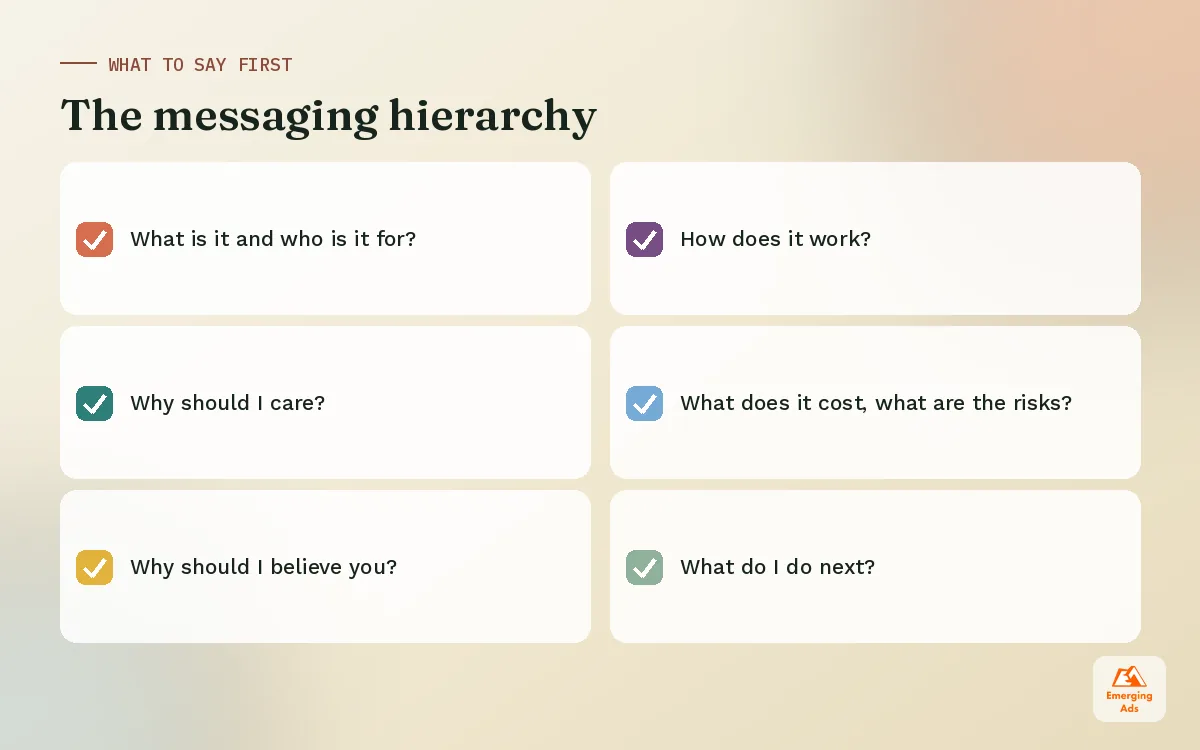
A messaging hierarchy sets the order in which you present information. Most buyers need answers in a predictable sequence, and pages that follow it convert better.
- What is it and who is it for? Clarity before creativity.
- Why should I care? The main benefit in the buyer’s terms.
- Why should I believe you? Proof, fast.
- How does it work? The method or process, simply explained.
- What does it cost and what are the risks? Pricing, guarantees, terms.
- What do I do next? One clear call to action.
This order is the backbone of every high-converting landing page we build. When we run conversion rate optimisation projects, restructuring pages around this hierarchy is often one of the quickest wins. Our main site explains more about how conversion rate optimisation works.
06Using the framework across channels
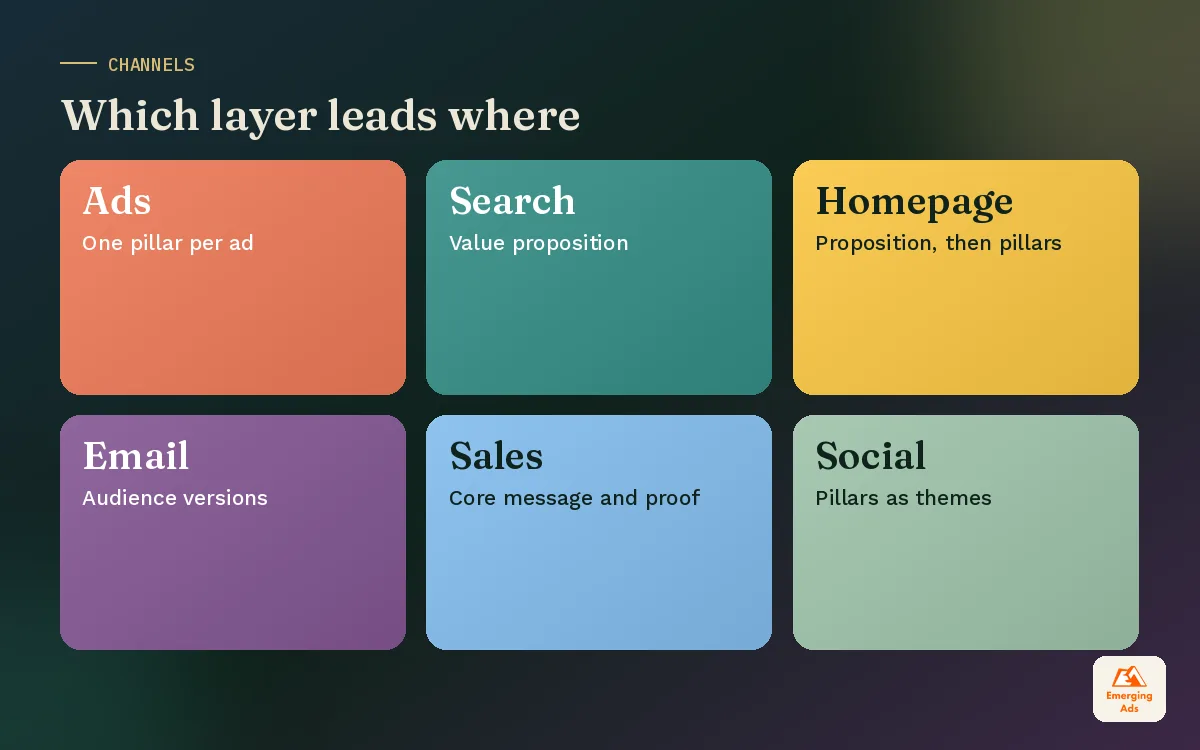
| Channel | Which layer leads | How it is adapted |
|---|---|---|
| Paid social ads | Pillars and proof | One pillar per ad, turned into a hook with a clear visual |
| Search ads | Value proposition | Benefit and difference squeezed into short headlines |
| Homepage | Value proposition, then pillars | Headline, subheadline, three pillars with proof |
| Audience versions | Tailored benefits by segment and lifecycle stage | |
| Sales deck | Core message and proof | Story arc from problem to proof to plan |
| Social content | Pillars | Each pillar becomes a recurring content theme |
The framework makes creative testing much more structured. Instead of random ideas, you test pillar against pillar in Meta ads and headline against headline in Google Ads, then feed the winners back into the website and emails. Our email copywriting and social media teams all work from the same framework for each client, which keeps every channel telling one story. It also gives your content strategy its main themes.
07Brand messaging examples: before and after
Illustrative rewrites showing how a framework sharpens real copy.
| Where | Before | After |
|---|---|---|
| Homepage headline | Innovative solutions for modern businesses | Bookkeeping for creative studios, done in a day each month |
| Ad hook | Transform your skincare routine today | Red, tight, reactive skin? Start with barrier repair. |
| Email subject | Our latest newsletter is here | The three reports every clinic owner should read weekly |
| Sales opener | We are a full-service agency | Most clinics we meet are paying for clicks, not patients |
Every “after” example names a specific audience or problem. That specificity comes straight from the framework.
08Messaging frameworks by business type
The structure stays the same across industries, but what goes into each layer changes. These are the patterns we see most often.
| Business type | Pillars that tend to matter | Proof buyers look for |
|---|---|---|
| DTC and ecommerce | Results, ingredients or materials, ease, value | Reviews, before and after, return policy |
| B2B services | Method, specialism, transparency, outcomes | Case studies with numbers, client logos, process |
| SaaS | Time saved, ease of adoption, integrations | Free trial, demos, customer quotes, security |
| Healthcare and clinics | Expertise, safety, patient experience | Credentials, patient reviews, clear process |
| Local services | Speed, reliability, fair pricing | Local reviews, guarantees, photos of real work |
If you sell online, your framework should also shape product pages and marketplace listings. That connection is a big part of our ecommerce marketing work, where one clear message runs from the ad through to the checkout.
Messaging for multiple audiences
Many businesses sell to more than one type of buyer. Resist the urge to create separate frameworks. Keep one core message and value proposition, then write audience versions that change the emphasis, examples and proof. That way the brand still sounds like one company while each buyer hears what matters to them.
09Keeping messaging consistent as you grow
- Store it where writers work. Link it in content briefs, ad briefs and sales playbooks.
- Build a message bank. Save approved headlines, hooks and proof lines so people reuse what works.
- Review quarterly. Update proof points, retire weak pillars and add winning lines from ad tests.
- Brief every partner. Agencies, freelancers and new hires should read it before writing anything.
- Align sales and marketing. Sit in on sales calls to hear whether the framework matches what buyers respond to.
10Messaging framework mistakes to avoid
- Too many pillars. More than four and nobody remembers any of them.
- Pillars without proof. Unsupported claims weaken the whole framework.
- Writing for the company, not the customer. Buyers care about their outcome, not your internal pride points.
- Jargon. Industry language often confuses the very people you want to reach.
- Set and forget. Markets shift. Messaging should learn from testing.
One more practical point: keep a changelog. When a pillar is replaced or a new proof point is added, note the date and the reason. Six months later, when someone asks why the homepage headline changed, the answer is already written down, along with the test results that justified it.
A messaging framework is one of the highest-value, lowest-cost brand projects a business can do. It usually takes two to three weeks and improves almost every piece of marketing that follows. Our branding and content team builds frameworks together with the paid media team, so the first ads to use them are live within days. See our success stories, explore brand identity design for the visual side, or book a free audit and we will trace your message across your ads and pages. You can also read the visual identity design guide to see how message and visuals fit together.
Frequently asked questions
Straight answers to what clients ask us most about brand messaging framework.
What is a brand messaging framework?
What is the difference between positioning and messaging?
What should a messaging framework include?
How many message pillars should a brand have?
What is a messaging hierarchy?
How long does it take to create a messaging framework?
Who should use the messaging framework?
How do I test brand messaging?
What is a value proposition?
How often should a messaging framework be updated?
What is the difference between a messaging framework and a tagline?
Do small businesses need a messaging framework?
Is your message getting lost between the ad and the checkout?
We will trace your message from ads to landing pages to emails and show you where it changes, weakens or disappears, with rewrites to test.
Book your free audit